IELTS Paragraph And Progression: Keep The Reader With You
Keep your reader with you from the first paragraph to the last: one topic per paragraph, references they can follow, and an essay that arrives somewhere. Not a linking-words course. Benchmarked to IELTS Band 6 to 7, useful whether or not you take the test.
One Paragraph, One Topic
Chapter 1
Chapter 1 · Start here
One Paragraph, One Topic
Say what each paragraph is about in one sentence. If you need the word and to do it, the paragraph has two topics.

Sprint 1
Say What This Paragraph Is About
Say what a paragraph is about in one sentence without using and, and spot paragraphs where you can't.

Sprint 2
The Sentence That Announces It
Write a sentence that tells the reader what the paragraph is about, and put it where the paragraph needs it, not always first.

Sprint 3
The Sentence That Belongs Somewhere Else
Find the sentence that doesn't belong to its paragraph and move or delete it, instead of smoothing it over with a linking word.

Sprint 4
Where A Paragraph Ends
Start a new paragraph when the topic changes, not after a set number of lines, and spot both the wall and the scatter.

Sprint 5
The Paragraph Serving The Essay
Name each paragraph's job in the essay, not just its topic, and find the paragraph doing another's job.

Sprint 6
How Many Paragraphs
Choose how many paragraphs to write from the question and your ideas, instead of a fixed four-paragraph template.

Sprint 7
Fix The Paragraphs, No Hints
Fix paragraph problems with nothing telling you which one is there, including when the right answer is to leave the text alone.
Pointing At Things Clearly
Chapter 2
Chapter 2 · Start here
Pointing At Things Clearly
Write this, it, they and such only where the reader can find what you mean, and name the thing where they can't.

Sprint 8
What Does "This" Point At
Check whether a this points at one thing the reader can find, and name the thing when it doesn't.

Sprint 9
It, They, And The Missing Antecedent
Use it and they only where one noun in the sentence before could replace them, and fix the rest.

Sprint 10
Naming What You Point At
Choose a noun that sums up what came before, a decline, a decision, a failure, without quietly changing your claim.

Sprint 11
The Former, The Latter, The Above
Use the former and the latter correctly, or avoid them, since they cost the reader more than they save you.

Sprint 12
Repeating The Noun Is Allowed
Repeat a key noun where a different word would confuse the reader, instead of varying words at the cost of clarity.

Sprint 13
Reference Across A Paragraph Break
Start a paragraph with a reference that clearly reaches back across the break; a bare it or this rarely survives one.

Sprint 14
Fix This, It And They, No Hints
Fix pointing-word problems with nothing telling you which one is there, including when naming the thing would only make the text heavier.
Linking Words That Earn Their Place
Chapter 3
Chapter 3 · Start here
Linking Words That Earn Their Place
Use a linking word where the link between two sentences would otherwise be unclear, and leave it out where it wouldn't.

Sprint 15
What A Linking Word Claims
Choose a linking word by how two sentences really relate, and spot one that claims a link the sentences don't have.

Sprint 16
However, Moreover, Therefore
Tell apart linking words that do the same job, moreover or in addition, however or nevertheless, and punctuate them correctly.

Sprint 17
The Mechanical Skeleton
Replace a Firstly, Secondly, Finally skeleton with links that say how your paragraphs really connect.

Sprint 18
One Per Paragraph Is Usually Enough
Remove linking words where the link is already clear, and stop starting every sentence with one.

Sprint 19
Cohesion Without A Connective
Link two sentences without a linking word: repeat a term, refer back, or put them in an order that shows the link.

Sprint 20
The Range The Descriptor Asks For
Vary the ways you link ideas across an essay, instead of relying on one device.

Sprint 21
Fix The Linking, No Hints
Fix one text with too many linking words and one with too few, without being told which is which.
Going Somewhere
Chapter 4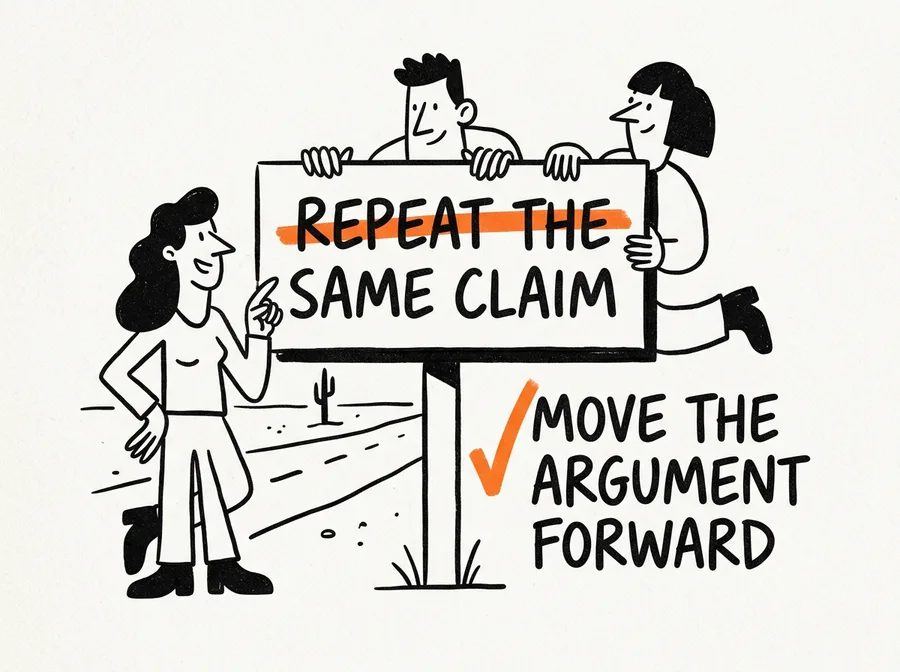
Chapter 4 · Start here
Going Somewhere
Write essays that arrive somewhere instead of circling, and paragraphs that move forward instead of repeating.

Sprint 22
Does This Paragraph Move
Check whether a paragraph's last sentence has moved beyond its first, and fix one that has circled back.

Sprint 23
The Order Of Your Paragraphs
Order your paragraphs by what depends on what, not by the order you thought of them, and find the pair that should swap.

Sprint 24
The Essay That Circles
Spot an essay whose conclusion arrives nowhere, and find the paragraph that failed to move it forward.

Sprint 25
The Order Inside A Paragraph
Order the sentences in a paragraph so each follows from the one before, and find the sentence that came too early.

Sprint 26
Signposting Without Numbering
Show the reader the shape of your essay through its content, not a numbered list, and see how little signposting you need.

Sprint 27
Progression Across Two Parts
Connect the two halves of a two-part answer so the second follows from the first instead of starting again.

Sprint 28
Fix The Order, No Hints
Fix order problems in sentences and paragraphs with nothing telling you which is there, by moving things rather than adding words.
The Whole Text
Chapter 5
Chapter 5 · Start here
The Whole Text
Check a finished essay in the time an exam leaves, find the problem that costs most, and fix that one.

Sprint 29
The Paragraph Map
Reduce a finished essay to one line per paragraph and read the lines alone. It shows most order and topic problems at once.

Sprint 30
Reading For Shape, Not For Meaning
Run checks on your own text that don't depend on understanding it, because understanding is what hides your own gaps.

Sprint 31
Your Over-use And Under-use Profile
Find out whether you personally link too much or too little, and which one linking habit you rely on.

Sprint 32
The Two Faults You Repeat
Name the two problems you personally repeat, and the check that catches each one.

Sprint 33
Coherence Under Time
Spend two minutes planning each paragraph's topic and job before writing. It prevents more problems than checking afterwards.

Sprint 34
Clear Beats Clever
Choose the plain link, the repeated noun and the ordinary paragraph break over more impressive options.

Sprint 35
Course Review — One Response, Read As A Stranger
Write a full essay and get a report on what a reader could and couldn't follow, across the whole course.