IELTS Complex Sentences: Join Two Ideas Without Breaking
Join two ideas in one sentence, and finish every sentence you start. Link words, clauses that describe a noun, if-sentences and -ing openers, with the control to use each one without breaking it. Benchmarked to IELTS Band 6 to 7, useful whether or not you take the test.
Two Ideas In One Sentence
Chapter 1
Chapter 1 · Start here
Two Ideas In One Sentence
One link word joins two clauses. Which word, which order, and which of the two ideas gets the loud half.

Sprint 1
What Makes A Sentence Complex
Find the main part and the dependent part of a sentence, and see why only one of them can stand alone.

Sprint 2
Choosing The Link Word
Choose between because, although, while, whereas, since and when by how the two ideas relate, instead of using because for everything.

Sprint 3
Front Or Back
Put the dependent part at the start or the end depending on what the paragraph needs, and punctuate each choice correctly.

Sprint 4
One Link Word, Not Two
Join two parts with one link word only: no although with but, no because with so.

Sprint 5
Which Idea Deserves The Main Clause
Put the idea you want the reader to accept in the main part, and the idea you are admitting or explaining in the other.

Sprint 6
Two In A Row Without Losing The Reader
Write a short paragraph that mixes long and short sentences, instead of only complex ones or only simple ones.

Sprint 7
Fix The Link Words, No Hints
Put every link-word rule together on text where nothing tells you which mistake is there.
The Clause That Describes A Noun
Chapter 2
Chapter 2 · Start here
The Clause That Describes A Noun
Attach a clause to a noun without repeating the subject, choose who, which or that, and use commas to show whether the clause identifies the noun or just adds to it.

Sprint 8
Who, Which, That
Choose who, which or that by whether the noun is a person or a thing, and know that that works for both.

Sprint 9
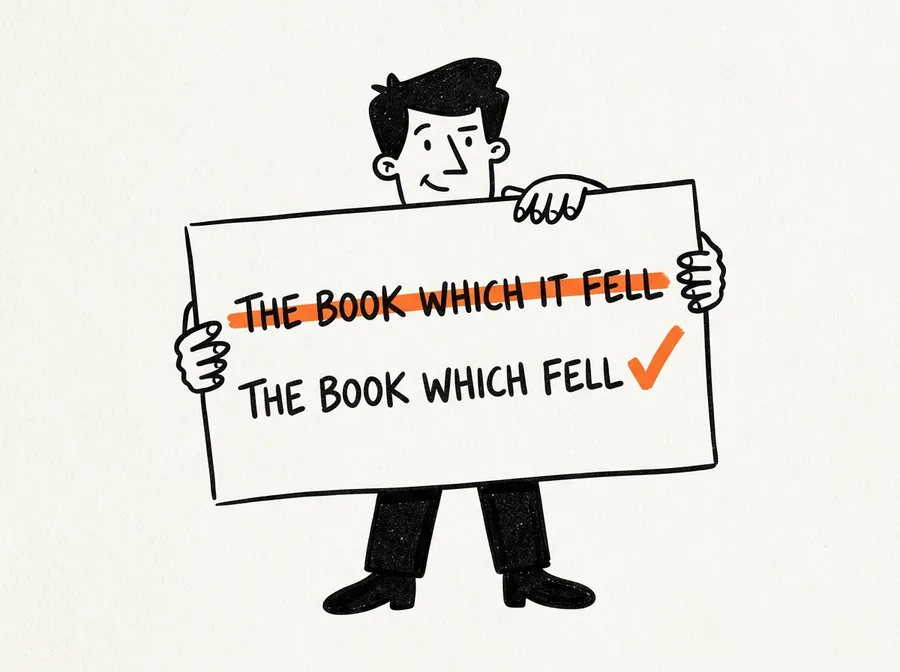
The Pronoun Is Already The Subject
Write a which or who clause with one subject, without repeating the noun as he, she or it inside it.

Sprint 10
The Comma Changes Who You Mean
Use commas around a which or who clause only when it adds information, and leave them out when it tells you which one.

Sprint 11
Whose, Where, When
Use whose for owning, where for places and when for times, instead of longer phrases that are easy to get wrong.

Sprint 12
Don't Bury The Verb
Keep the main verb close to its subject so the reader can find it, and split the sentence when a clause pushes them too far apart.

Sprint 13
Cutting The Pronoun
Shorten a which or who clause by dropping the pronoun and the verb be, and learn the two cases where you can't.

Sprint 14
Fix The Noun Clauses, No Hints
Put every which, who and that rule together on text where nothing tells you which mistake is there.
If, And The Frame That Follows It
Chapter 3
Chapter 3 · Start here
If, And The Frame That Follows It
Choose between a real and an imagined condition, keep the verbs matched across the sentence, and use if to limit a claim rather than to dream.

Sprint 15
Real Conditions
Write a real condition as if plus present, then will plus verb, in either order.

Sprint 16
The Error That Survives Everything
Stop writing will straight after if, and produce the correct half without thinking.

Sprint 17
Unreal Conditions
Write an imagined condition as if plus past, then would plus verb, and choose between real and imagined by whether it could happen.

Sprint 18
Unless, As Long As, Provided That
Use unless to mean if not, and stop adding a second negative to it.

Sprint 19
Holding The Frame
Keep the same if-pattern across a whole sentence, even when another clause is added at the end.

Sprint 20
Hedging A Claim
Use an if-sentence to limit a claim rather than to imagine, which is what it is really for in an essay.

Sprint 21
Fix The If-Sentences, No Hints
Put every if-sentence rule together on text where nothing tells you which mistake is there.
Saying It In Fewer Words
Chapter 4
Chapter 4 · Start here
Saying It In Fewer Words
Open a sentence with an -ing or -ed phrase, attach one to a noun, and make sure it belongs to the right subject.

Sprint 22
Cutting To A Participle
Replace a full which or who clause with an -ing or -ed word where the clause contains be.

Sprint 23
-ing And -ed
Choose -ing when the noun does the action and -ed when it receives it, in phrases and in adjectives.

Sprint 24
Opening With A Participle
Open a sentence with an -ing phrase, put a comma after it, and follow it straight away with the person or thing doing it.

Sprint 25
The Dangling Modifier
Spot an opening phrase that belongs to the wrong subject, and fix it by changing the main part of the sentence.

Sprint 26
From Two Sentences To One
Combine two related sentences with an -ing phrase instead of a link word, and know when the link word is better.

Sprint 27
Compression Without Loss
Notice when a shortened sentence has lost something the reader needed, usually who did it and when, and put it back.

Sprint 28
Fix The Shortened Sentences, No Hints
Put every shortening rule together on text where nothing tells you which mistake is there.
Using Every Structure Without Breaking It
Chapter 5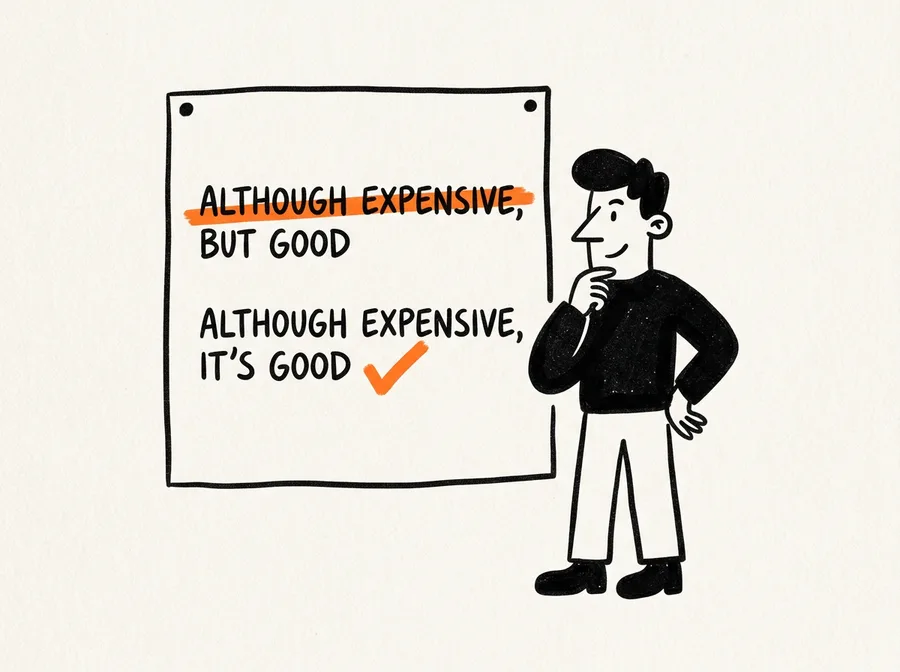
Chapter 5 · Start here
Using Every Structure Without Breaking It
Choose between the four structures in this course, keep them going across a paragraph, and stop before a sentence gets away from you.

Sprint 29
How Long Is Too Long
Find the point where your own sentence stops being under control, and cut it there, not at a word count.

Sprint 30
The Simple Sentence Is Part Of The Range
Write a paragraph that mixes simple and complex sentences, and stop seeing every simple sentence as a missed chance.

Sprint 31
Finding The Sentence That Broke
Read your own paragraph and find the complex sentence that broke, without being told which one.
Sprint 32
The Two Structures You Avoid
Name the two structures you never use, and write one sentence with each.

Sprint 33
Writing Complex Under Time
Write varied complex sentences at exam speed, and drop a sentence that is going wrong instead of trying to rescue it.

Sprint 34
Accurate And Simple Beats Complex And Broken
Choose the version of a sentence you can finish correctly, and stop reaching for a structure you can't control.

Sprint 35
Course Review — A Paragraph With Three Structures
Write one essay paragraph with three different complex structures, and get a report across the whole course.