IELTS Word Forms: Fix The Words You Already Know
Stop guessing between danger and dangerous. Learn how to read the sentence slot before you choose the word, spell the academic words examiners see most, replace the five words you repeat, and remove the errors that make known words score as unknown.
Word Families: Picking The Right Form
Chapter 1
Chapter 1 · Start here
Word Families: Picking The Right Form
Read the gap before you choose the word: noun, verb, adjective or adverb. Practise it on forty everyday word families, from decide to society.

Sprint 1
Thinking Words: Decide, Decision Or Decisive?
Eight words you already know, like decide, believe and remember, and the three-second check that tells you which form a sentence needs.

Sprint 2
Value Words: Important Or Importance?
Important, benefit, necessary, useful: the words in almost every Task 2 essay, and when each one needs its noun or its adjective form.

Sprint 3
Problem Words: Danger Or Dangerous?
Why 'very danger' is the most common Band 5 mistake, how to fix it, and the smaller errors around it, like harmful and harmless.

Sprint 4
Success Words: Succeed, Success, Successful
Words like succeed, achieve and able change their spelling as well as their ending. Learn where the letters move, and stop writing succesful and achievment.

Sprint 5
Society Words: Society Or The Society?
Society, culture, community, tradition: the words in every social-topic essay, their forms, and when they need 'the'.

Sprint 6
Review: The Forms You Now Control
Every word family from this chapter in one place. Test yourself, find the group of words you still get wrong, and write one short paragraph.
Spelling That Costs Marks
Chapter 2
Chapter 2 · Start here
Spelling That Costs Marks
Fix the academic spellings that cost marks in both Writing and Listening.

Sprint 7
Double Letters
The common words whose only trap is which letter doubles, with a trick for remembering each one.

Sprint 8
Silent Letters: Words That Don't Sound Like Their Spelling
Words you can say but not spell, because a letter is silent or the sound doesn't match. This is where most spelling marks go in Listening.

Sprint 9
The -ent And -ant Endings
-ent or -ant, -ence or -ance: they sound the same, so your ear can't help. Learn which words take which ending.

Sprint 10
Words That Change Shape
Nouns that change their spelling instead of just adding an ending, so you stop writing words that don't exist.

Sprint 11
Words That Sound The Same
Pairs that sound alike but mean different things, and how to tell them apart in writing and in Listening.

Sprint 12
Review: The Letters You Now Control
Every spelling from this chapter in one place. Test yourself, find the trap that still catches you, and write a few sentences.
Enough Words To Finish The Task
Chapter 3
Chapter 3 · Start here
Enough Words To Finish The Task
Replace the five words you repeat, and link ideas without running out.

Sprint 13
Linking Your Ideas
A small set of linking words to join your ideas, and how to punctuate each one correctly.

Sprint 14
Instead Of "Very" And "A Lot"
Stop repeating very and a lot: better words that fit the word they describe.

Sprint 15
Instead Of "Good" And "Bad"
Words that say what kind of good or bad you mean, instead of the two most overused words in English.

Sprint 16
Instead Of "People" And "Thing"
Name groups and ideas precisely. It is the quickest way to stop an essay sounding repetitive.

Sprint 17
Referring Back Without Repeating
Point back to an idea you already mentioned without writing the same noun again.

Sprint 18
Review: Enough Words To Finish
All the replacement words from this chapter. Test yourself, then write a paragraph without leaning on the same five words.
Describing People, Places And Feelings
Chapter 4
Chapter 4 · Start here
Describing People, Places And Feelings
Describe people, places, feelings and past habits for Speaking Parts 1 and 2.

Sprint 19
Describing People
Words for someone's character that say more than nice, and how to back each one up with an example.

Sprint 20
Describing Places
Words for places that actually tell the listener something, instead of beautiful and nice.

Sprint 21
Describing Feelings
Name a feeling exactly and say what caused it, the way a good Speaking Part 2 story does.

Sprint 22
Giving An Opinion Clearly
Different ways to give your opinion when you speak, so you don't start every answer with I think.

Sprint 23
Talking About The Past And Habits
How to talk about what you used to do and how things have changed, which most Speaking questions ask for.

Sprint 24
Review: Enough Words To Speak For Two Minutes
All the describing words from this chapter. Test yourself, then give a two-minute spoken answer.
Describing A Chart: Change, Numbers And Comparison
Chapter 5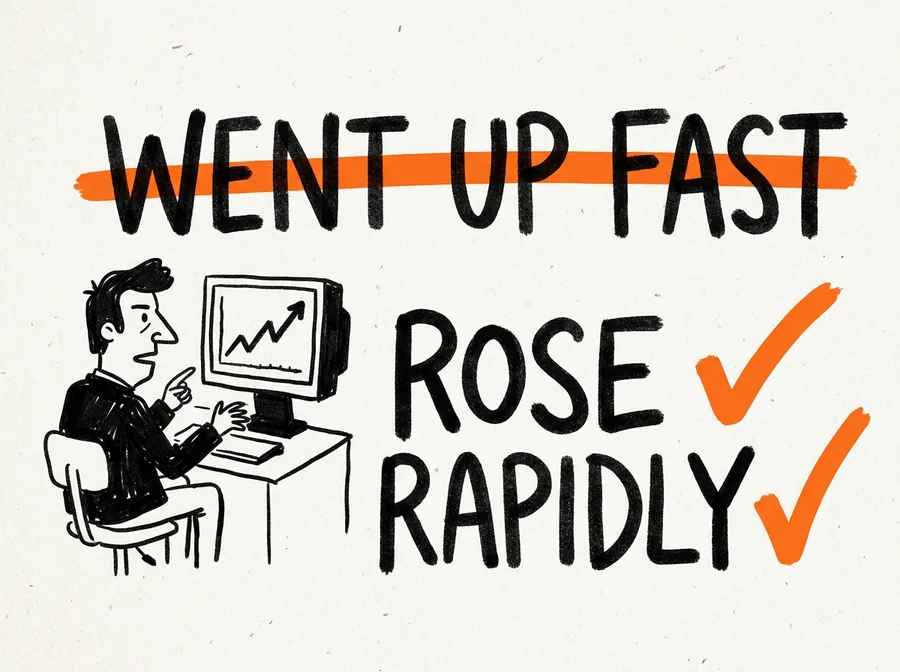
Chapter 5 · Start here
Describing A Chart: Change, Numbers And Comparison
Describe a chart accurately: change words, proportions, and comparison prepositions.

Sprint 25
Words For Change
Rise, fall, stay steady: the verbs and nouns for describing how a line on a chart moves.

Sprint 26
Size And Speed Of Change
Say how much and how fast something changed, using both the adverb and the adjective form.

Sprint 27
Numbers And Proportions
Report figures and percentages with the right words, and get singular and plural right.

Sprint 28
Comparing Two Figures
Compare numbers correctly, including the small word that comes after each comparison.

Sprint 29
Task 1 Sentence Frames
Reliable sentence frames for a full four-paragraph Task 1 answer, without memorised template phrases.

Sprint 30
Review: Describing A Chart Accurately
All the chart words from this chapter. Test yourself, then write a short Task 1 answer where getting the numbers right comes first.
Topic Words: Environment, Technology, Health, Education, Work
Chapter 6
Chapter 6 · Start here
Topic Words: Environment, Technology, Health, Education, Work
The plain vocabulary for the five topics that dominate IELTS prompts.

Sprint 31
Environment Words
The plain words you need to write and talk about the environment, in their correct forms.

Sprint 32
Technology Words
Plain words for technology topics, and the countable and uncountable traps that are common in this area.

Sprint 33
Health Words
Words for health topics in their correct forms, and the fixed word pairs this topic uses.

Sprint 34
Education Words
Plain words for schools, universities and learning, in their correct forms.

Sprint 35
Work And Money Words
Words for jobs and money, and the small words that always follow them.

Sprint 36
Review: Something Concrete To Say
All the topic words from this chapter. Test yourself, then write a paragraph that says something specific, not general.
The Eight Errors That Cost The Most Marks
Chapter 7
Chapter 7 · Start here
The Eight Errors That Cost The Most Marks
Remove the eight errors that make known words score as unknown.

Sprint 37
The Wrong Form In The Gap
The noun and adjective forms people mix up most, checked quickly and under time pressure.

Sprint 38
Prepositions After Common Words
The small word that always follows common adjectives. There is no rule, so you learn each pair together.

Sprint 39
Countable And Uncountable Nouns
Stop adding -s to nouns that can't be counted, one of the easiest mistakes for a reader to spot.

Sprint 40
Verb Patterns
After common verbs, do you need -ing or to? Learn the pattern for each verb so you stop guessing.

Sprint 41
The Errors To Stop Making
The eight mistakes that come up most often, and how to find and remove them from your own writing.

Sprint 42
Review: Find Them Before The Examiner Does
One paragraph with every kind of error from this chapter hidden in it. Find and fix them all.