Two Bars, Four Structures
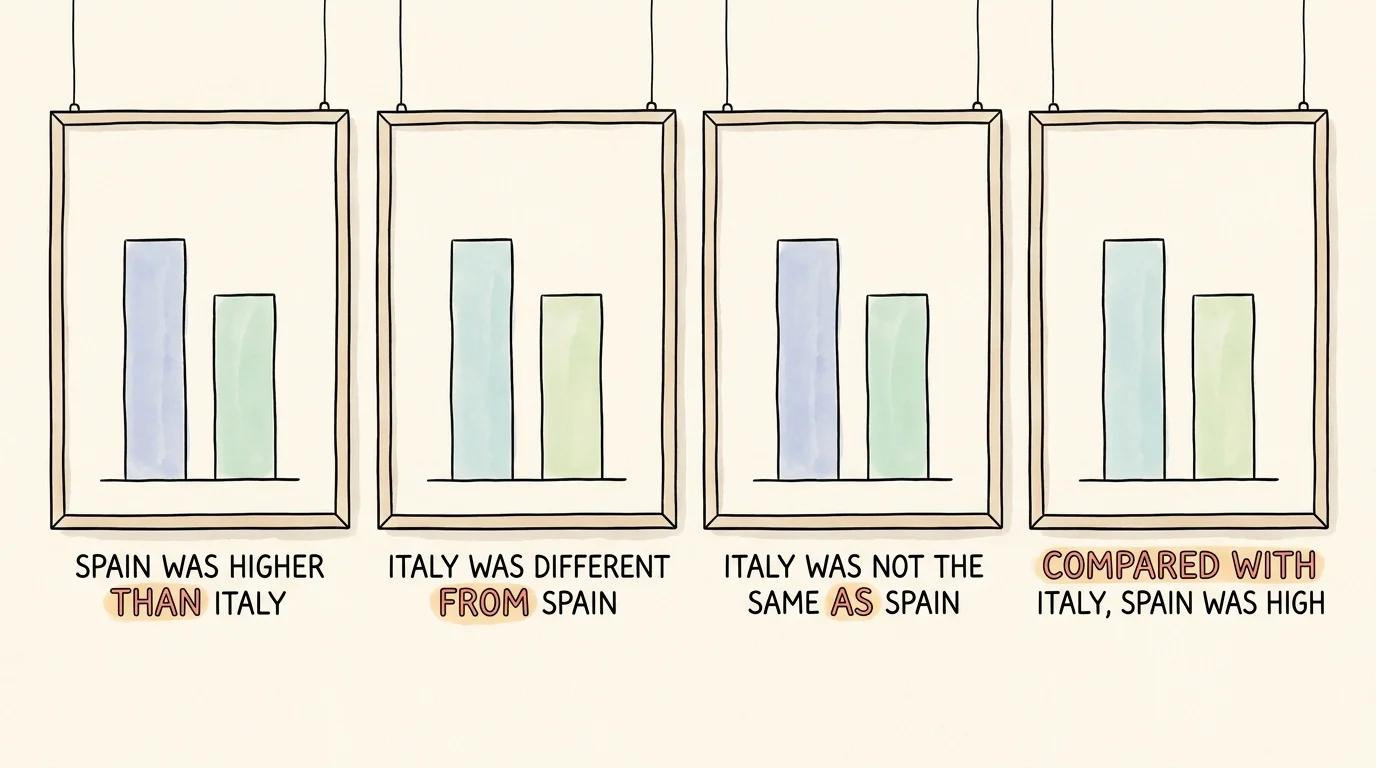
The same two bars, described four different ways.
Click to zoom
The bars never change. Only the small word in the middle of each sentence does.
Compare numbers correctly, including the small word that comes after each comparison.
Preview · progress not saved — Chapter 1 is free
Spain 62%, Italy 41%. Seven sentences about that — one of them is not English.
You already know the comparison words. The marks are lost on the word after them.
Spain is more than Italy is the sentence most Band 5 candidates write here, and it is not really English. Spain is a country; Italy is a country. Neither is "more" than the other.
What is higher is the figure: The figure for Spain was higher than the figure for Italy.
Every other way of saying it is correct. What separates them is the small word that follows — than, from, with, to, of — and that is what this sprint fixes.
The same two bars, described four different ways.
The bars never change. Only the small word in the middle of each sentence does.
Eight comparison words. Attach the right small word to each.
Terms
Definitions
Three decisions, each turning on how many things are being compared.
Chain 1
The data: two countries only — Spain 62%, Italy 41%.
Candidates: higher than / the highest of
The structure:
Because:
Chain 2
The data: four countries — Spain 62%, Italy 41%, Greece 39%, Portugal 28%.
Candidates: higher than / the highest of
The structure for Spain:
Because:
Chain 3
The data: Italy 41% and Greece 39% — almost identical.
Candidates: different from / similar to
The structure:
Because:
A Task 1 paragraph — four gaps want a comparison word, four want its preposition.
Households with home internet access, 2020 (%)
Spain 62 · Italy 41 · Greece 39 · Portugal 28
Spain recorded the figure of the four countries, at 62 per cent. This was considerably than the figure for Italy, which stood at 41 per cent.
The figures for Italy and Greece were very to one another — 41 and 39 per cent respectively, a gap of only two percentage points. Portugal, by contrast, was clearly different the other three, recording the figure at 28 per cent.
Compared Spain, Portugal's access rate was less than half. In other words, the figure Spain was more than twice high as the Portuguese one.