Curiosity: Class 6 Science (NCERT)
NCERT's Class 6 Science textbook, Curiosity: learn science through activities and experiments instead of memorising. It brings together living things, materials, forces, the Earth and space through real-life stories and questions to think about.
The Wonderful World Of Science
Chapter 1
Chapter 1 · Start here
The Wonderful World Of Science
What science really is, the questions it asks about the world around you, and the steps scientists follow to find answers.

Sprint 1
The Nature Of Science
Science is a way of thinking driven by curiosity, from grains of sand to distant stars.

Sprint 2
What Science Helps Us Understand
The everyday things science explains: living things, food, water, materials and space.

Sprint 3
The Scientific Method
The steps scientists use to find answers, and why everyone uses them, starting with a pen that won't write.
Sprint 4
Review: The Wonderful World Of Science
Check what science is and the steps of the scientific method, then try them on a new puzzle.
Diversity In The Living World
Chapter 2
Chapter 2 · Start here
Diversity In The Living World
The huge variety of plants and animals around you, how to group them, and how living things depend on each other.

Sprint 5
Grouping Plants: Herbs, Shrubs, And Trees
Classify plants based on their height, stem properties, and branching patterns.

Sprint 6
The Secret Code Of Plants: Roots, Leaves, And Seeds
Understand the correlation between a plant's seed type (dicot/monocot), leaf venation, and root system.

Sprint 7
Grouping Animals By Movement
Understand that animals can be classified by their diverse types of movement and the specific body parts they use.
Sprint 8
Habitats And Amazing Adaptations
Define habitat and adaptation, and explore how specific plants and animals adapt to distinct environments like deserts, mountains, and oceans.

Sprint 9
Protecting The Web Of Life
Understand the threats to biodiversity and the modern and traditional methods used to conserve it.
Sprint 10
Review: Diversity In The Living World
Synthesize the classifications, adaptations, and conservation principles covered in the chapter.
Mindful Eating: A Path To A Healthy Body
Chapter 3
Chapter 3 · Start here
Mindful Eating: A Path To A Healthy Body
What is inside the food you eat, why your body needs each part, and how to eat well.
Sprint 11
Food Diversity & Culinary Practices
Understand how geography, climate, and time shape what we eat and how we cook it.

Sprint 12
Macronutrients & How To Test Them
Understand the roles of Carbohydrates, Fats, and Proteins, and learn the laboratory tests used to detect them in food.
Sprint 13
Protective Nutrients: Vitamins & Minerals
Identify the functions of specific vitamins and minerals, and correlate their deficiencies with specific diseases.
Sprint 14
Dietary Fibres, Water & The Balanced Diet
Understand the non-nutrient essentials (fibre, water) and how all components combine into a balanced diet, contrasting with junk food.

Sprint 15
Millets & Food Miles
Appreciate the nutritional value of native grains (millets) and understand the environmental and social journey of food (food miles).
Sprint 16
Chapter Review: Mindful Eating
Synthesize and test the learner's knowledge of nutrients, their tests, deficiency diseases, and sustainable eating habits.
Exploring Magnets
Chapter 4
Chapter 4 · Start here
Exploring Magnets
How magnets attract and repel, how they point north, and how people used them to find their way.

Sprint 17
Materials & Magnet Shapes
Distinguish between magnetic and non-magnetic materials, and recognize the various shapes artificial magnets take.

Sprint 18
The Power Of Poles
Understand that magnetic strength is concentrated at the poles, and that these poles always exist in unbreakable pairs.
Sprint 19
Navigation & Creating Magnets
Explain how freely suspended magnets align with Earth's magnetic field to indicate direction, and demonstrate how to magnetize iron.

Sprint 20
Attraction, Repulsion & Magnet Care
Learn the rules of magnetic interaction (attraction/repulsion), recognize repulsion as the true test of a magnet, and learn how to prevent demagnetization.
Sprint 21
Chapter Review: Magnets
Consolidate vocabulary, apply interaction rules to complex scenarios, and synthesize the chapter's core principles.
Measurement Of Length And Motion
Chapter 5
Chapter 5 · Start here
Measurement Of Length And Motion
How to measure length correctly, why we need standard units, and how to describe things that move.

Sprint 22
From Handspans To Standard Units
Explain why non-standard units fail and why the SI system (metres) is necessary.

Sprint 23
The Art Of Accurate Measurement
Teach the practical skills of using a scale correctly and measuring non-straight objects.

Sprint 24
Position, Rest, And Motion
Define motion entirely as a change in position relative to a chosen reference point over time.

Sprint 25
Types Of Motion
Classify motion into linear, circular, and oscillatory/periodic categories.
Sprint 26
Chapter Review
Synthesize concepts of unit conversions, accurate measurement, reference points, and types of motion.
Materials Around Us
Chapter 6
Chapter 6 · Start here
Materials Around Us
What things are made of, and how the properties of materials decide what we use them for.

Sprint 27
What Are Materials And Why Group Them?
Distinguish between objects and materials, and understand that grouping (classification) helps us study properties.

Sprint 28
Properties: Appearance And Hardness
Classify materials based on how they look (lustrous/non-lustrous) and how they feel (hard/soft).

Sprint 29
Properties: Transparency And Solubility
Understand how light passes through materials (transparency) and how materials behave in water (solubility).

Sprint 30
Matter, Mass, And Volume
Define matter conceptually as anything that has mass and occupies space (volume).
Sprint 31
Comparing Materials At A Glance
Synthesize the properties of common materials into a structured framework.
Sprint 32
Chapter Review
Retrieve, assess, and apply all knowledge from the chapter.
Temperature And Its Measurement
Chapter 7
Chapter 7 · Start here
Temperature And Its Measurement
Why touch can't tell you how hot something is, and how to measure temperature with a thermometer.

Sprint 33
Clinical Thermometers & Body Heat
Understand how clinical thermometers work, normal body temperature ranges, and temperature scales (Celsius, Fahrenheit, Kelvin).

Sprint 34
Laboratory Thermometers In Action
Learn the structure, usage protocols, and mathematical reading of a laboratory thermometer.

Sprint 35
Comparing Thermometers
Clearly distinguish between clinical and laboratory thermometers across multiple criteria.

Sprint 36
Weather, Extremes, And Air Temperature
Understand how air temperature is measured, weather reports, and the extreme limits of temperature in the universe.
Sprint 37
Chapter Review: Temperature & Measurement
Synthesize chapter concepts, test application of rules, and ensure robust recall of vocabulary and procedures.
A Journey Through States Of Water
Chapter 8
Chapter 8 · Start here
A Journey Through States Of Water
How water changes between ice, liquid and vapour, and where it hides in the air around you.

Sprint 38
The Disappearing And Appearing Acts
Understand that water can turn into invisible gas (evaporation) and turn back into liquid when touching a cold surface (condensation).

Sprint 39
The Three States Of Water
Differentiate between solid, liquid, and gaseous water based on shape, flow, and spreading behavior, and understand melting/freezing.

Sprint 40
Faster Evaporation And The Cooling Effect
Identify the factors that speed up or slow down evaporation, and understand why evaporation causes a cooling effect on its surroundings.

Sprint 41
Clouds, Rain, And The Water Cycle
Connect evaporation and condensation on a global scale to understand how clouds form and how the water cycle sustains Earth.
Sprint 42
Chapter Review
Synthesize the concepts of evaporation, condensation, states of matter, and the water cycle into a comprehensive understanding.
Methods Of Separation In Everyday Life
Chapter 9
Chapter 9 · Start here
Methods Of Separation In Everyday Life
Most things in nature are mixtures. Learn the everyday ways we separate the useful parts from the rest.
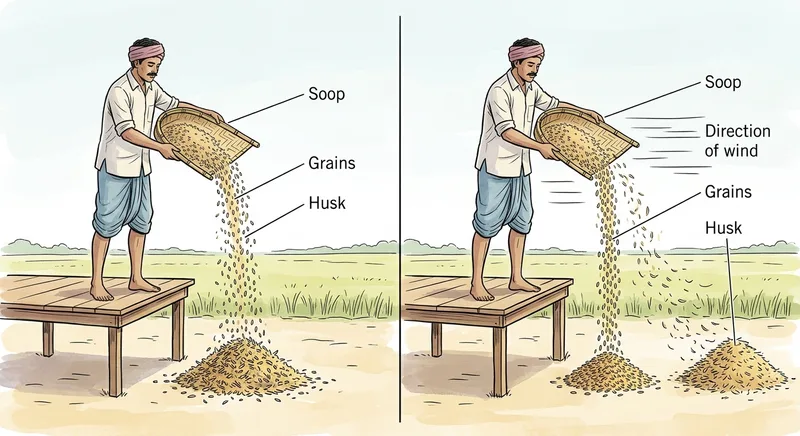
Sprint 43
Separating Solid Mixtures: By Hand, Force, And Wind
Understand how physical differences in size, color, shape, and weight allow us to separate solid mixtures using handpicking, threshing, and winnowing.

Sprint 44
Separation By Size And Magnetism
Learn how specific physical properties—distinct particle sizes and magnetic attraction—allow for precise separation.

Sprint 45
Separating Insoluble Solids From Liquids
Understand how gravity and porous barriers help separate insoluble solids from liquids through sedimentation, decantation, and filtration.

Sprint 46
Separating Dissolved Solids And Emulsions
Learn methods to separate substances that are uniformly mixed or dissolved, specifically evaporation for solutions and churning for liquid emulsions.
Sprint 47
Chapter Review: Master Separation Methods
Synthesize all separation methods, match them to appropriate mixtures, and apply reasoning to multi-step separation challenges.
Living Creatures: Exploring Their Characteristics
Chapter 10
Chapter 10 · Start here
Living Creatures: Exploring Their Characteristics
What makes something alive: the features all living things share.

Sprint 48
What Makes A Living Creature?
Understand and apply the 7 essential characteristics of living beings to differentiate them from non-living things.

Sprint 49
Plant Life: Seeds, Growth, And Movement
Analyze the conditions required for seed germination and explain how plants respond to light and gravity.

Sprint 50
The Circle Of Life
Compare the distinct developmental stages in the life cycles of a plant, a mosquito, and a frog.
Sprint 51
Review: Living Creatures
Synthesize understanding of the characteristics of life, germination conditions, and developmental life cycles.
Nature's Treasures
Chapter 11
Chapter 11 · Start here
Nature's Treasures
The natural resources that support life, like air, water, soil and sunlight, and why we must use them wisely.

Sprint 52
Air And Water: Essential Treasures
Understand the composition and importance of air (including wind energy) and the sources, scarcity, and conservation of freshwater.

Sprint 53
The Sun And Forests: Life's Foundations
Understand the Sun as the ultimate source of energy and how forests support biodiversity and require conservation.

Sprint 54
Beneath Our Feet: Soil, Rocks, And Minerals
Understand how soil is formed through weathering, identify different types of rocks, and understand their uses and the minerals extracted from them.

Sprint 55
Understanding Our Resources
Define fossil fuels, and classify all natural resources into renewable and non-renewable categories.
Sprint 56
Chapter Review: Nature's Treasures
Synthesize the concepts of natural resources, their uses, conservation, and categorization.
Beyond Earth
Chapter 12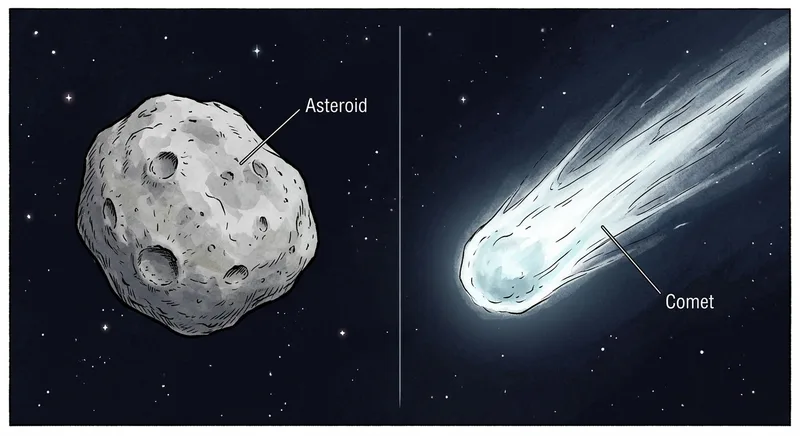
Chapter 12 · Start here
Beyond Earth
The Moon, stars, planets and constellations: what you can see in the night sky, and our place in space.

Sprint 57
Stars & Constellations
Understand what stars are, how light pollution affects visibility, and how humans group stars into constellations for navigation.

Sprint 58
The Sun & Planets
Understand the Sun as the center of our solar system and categorize the 8 planets by their relative positions and characteristics.

Sprint 59
Moons, Asteroids & Comets
Identify the smaller bodies in the solar system: natural satellites, asteroids, and comets.

Sprint 60
Galaxies & The Universe
Understand that the Solar System is part of the Milky Way galaxy, which is one of many in the vast universe.
Sprint 61
Chapter Review
Synthesize and recall all concepts related to stars, constellations, the solar system, and galaxies.