Class 10 Mathematics (NCERT)
NCERT's Class 10 Mathematics textbook, explained step by step with real-world problems and clear reasoning. It covers algebra, geometry, trigonometry, measurement and statistics. Each chapter is split into short lessons with worked examples, practice and quick checks.
Quadratic Equations
Chapter 1Chapter 1 · Start here
Quadratic Equations
Turn real problems into quadratic equations, and solve them by factorising or with the quadratic formula.
Sprint 1
Identifying Quadratic Equations
Recognise a quadratic equation, and turn a real situation into one.
Sprint 2
Solving By Factorisation
Find the roots of a quadratic equation by splitting the middle term.
Sprint 3
The Quadratic Formula And The Nature Of Roots
Use the discriminant to tell what kind of roots an equation has, and the quadratic formula to find them.
Sprint 4
Review: Quadratic Equations
Put identifying, factorising and the discriminant together on mixed problems.
Arithmetic Progressions
Chapter 2
Chapter 2 · Start here
Arithmetic Progressions
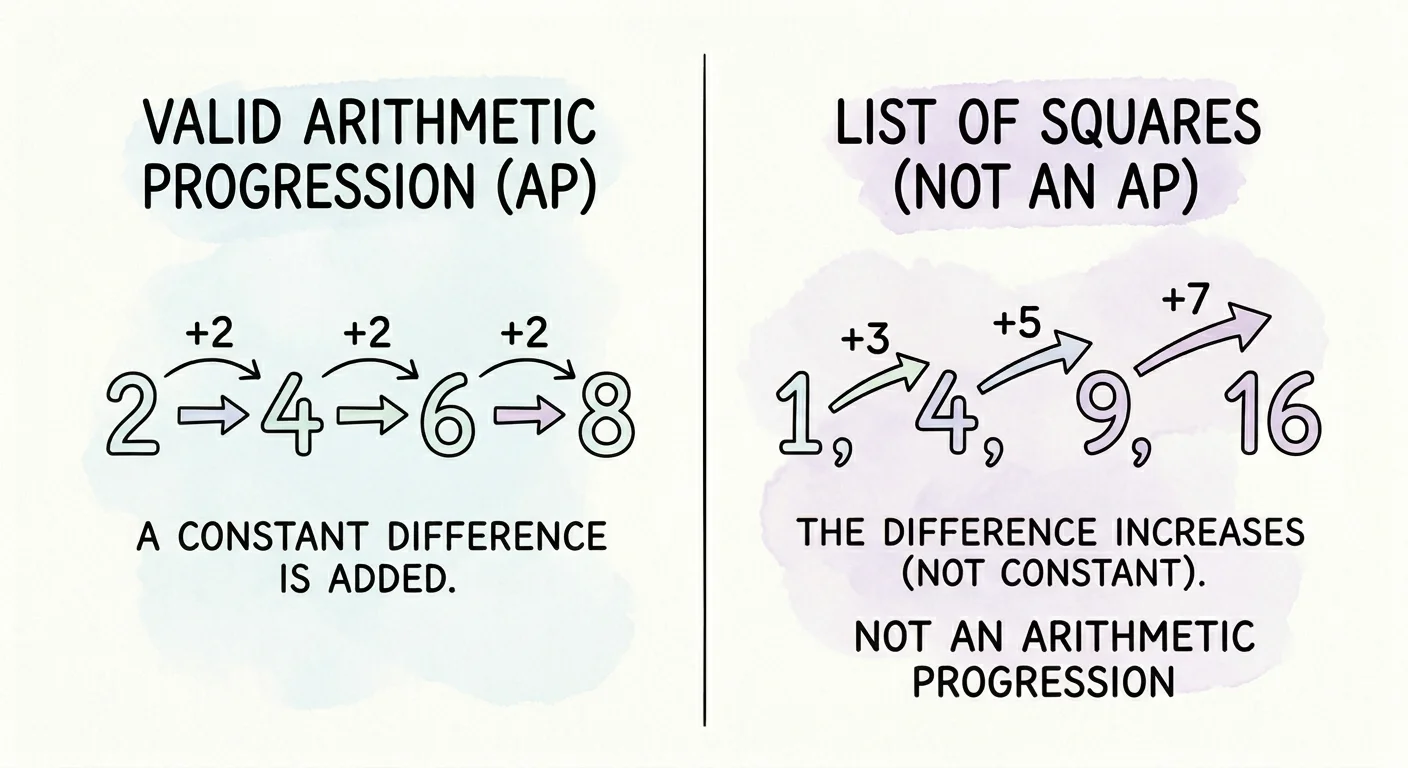
Number patterns that grow by the same amount each time: find any term, and add up the terms.
Sprint 5
Introducing Arithmetic Progressions
Define an AP, identify its first term and common difference, and construct a sequence from them.

Sprint 6
The Nth Term Of An AP
Derive and apply the general formula for the nth term of an AP.

Sprint 7
Applications Of The Nth Term
Use the nth term formula to find 'n', check if a number is in a sequence, and solve word problems.
Sprint 8
Sum Of First N Terms Of An AP
Derive and apply the sum formula for an Arithmetic Progression.
Sprint 9
Advanced Sum Applications
Solve quadratic equations arising from AP sums and model complex scenarios.
Sprint 10
Chapter Review: Arithmetic Progressions
Synthesize the identification, term formulas, and sum formulas of APs in mixed-context problems.
Triangles
Chapter 3Chapter 3 · Start here
Triangles
Similar triangles: the Basic Proportionality Theorem, and the tests for similarity (AA, SSS, SAS).
Sprint 11
The Basic Proportionality Theorem
Understand and apply the Basic Proportionality Theorem (Thales Theorem) to find missing side lengths in triangles.
Sprint 12
Converse Of BPT And Applications
Apply the converse of the Basic Proportionality Theorem to prove lines are parallel.
Sprint 13
Similarity Criteria: AAA And AA
Identify similar triangles using the AAA and AA criteria, and write similarity correctly using vertex correspondence.
Sprint 14
Similarity Criteria: SSS And SAS
Master the SSS and SAS similarity criteria and apply them to complex geometric and real-world problems.
Sprint 15
Chapter Review: Triangles
Synthesize BPT, AAA, SSS, and SAS criteria to solve complex geometric proofs and calculations.
Coordinate Geometry
Chapter 4Chapter 4 · Start here
Coordinate Geometry
Find the distance between two points, and the point that divides a line in a given ratio.
Sprint 16
The Distance Formula
Derive and apply the algebraic formula for the distance between any two points.
Sprint 17
Geometric Shapes & Equidistance
Use the distance formula to prove geometric properties and find equidistant points.
Sprint 18
The Section Formula
Derive and apply the section formula for internal division of a line segment.
Sprint 19
Finding Ratios And Mid-Points
Use the k:1 technique to find unknown ratios, and apply the mid-point formula for 1:1 division.
Sprint 20
Review: Coordinate Geometry
Synthesize distance and section formulas to solve multi-step geometric problems.
Introduction To Trigonometry
Chapter 5Chapter 5 · Start here
Introduction To Trigonometry
Sine, cosine and tangent: what they are, their values at special angles, and the key identities.
Sprint 21
Defining Trigonometric Ratios
Define sine, cosine, tangent, and their reciprocals relative to an acute angle in a right triangle.
Sprint 22
Calculating All Trigonometric Ratios
Learn to calculate all six trigonometric ratios if one ratio is given by using the Pythagorean theorem.
Sprint 23
Trigonometric Ratios Of 30°, 45°, And 60°
Derive and use the trigonometric ratios for 30, 45, and 60 degrees using geometric properties.
Sprint 24
Trigonometric Ratios Of 0° And 90°
Understand the limiting behavior of right triangles as angles approach 0 or 90 degrees.
Sprint 25
Trigonometric Identities
Derive and apply the three fundamental Pythagorean identities.
Sprint 26
Chapter Review
Consolidate learning across all trigonometric ratios, exact angles, and identities.
Some Applications Of Trigonometry
Chapter 6Chapter 6 · Start here
Some Applications Of Trigonometry
Use trigonometry to find heights and distances you can't measure directly.
Sprint 27
Single Right Triangle Models
Master the translation of real-world scenarios into a single right triangle and solve it using basic trig ratios.
Sprint 28
Double Triangle Models
Master solving problems with two right triangles by identifying the shared side and substituting equations.
Sprint 29
Chapter Review: Heights And Distances
Synthesize chapter skills by applying trigonometric models to varied, mixed-difficulty real-world scenarios.
Circles
Chapter 7Chapter 7 · Start here
Circles
Tangents to a circle: why a tangent meets the radius at a right angle, and why tangents from one point are equal.
Sprint 30
Intersecting Lines: Secants And Tangents
Student can formally distinguish between non-intersecting lines, secants, and tangents, and define the point of contact.
Sprint 31
The Tangent-Radius Theorem
Student can prove and apply Theorem 10.1 (tangent is perpendicular to radius at point of contact) to find missing lengths.
Sprint 32
Tangents From An External Point
Student can state the number of tangents from points relative to the circle and prove/apply Theorem 10.2 (Lengths of external tangents are equal).
Sprint 33
Complex Tangent Systems
Student can combine perpendicularity (Theorem 10.1) and equal lengths (Theorem 10.2) to solve complex multi-step geometric proofs and calculation problems.
Sprint 34
Chapter Review: Circles
Consolidate understanding of tangent properties and apply them to mixed-difficulty proofs and calculations.
Areas Related To Circles
Chapter 8Chapter 8 · Start here
Areas Related To Circles
Find the length of an arc and the areas of sectors and segments of a circle.
Sprint 35
Length Of An Arc And Area Of A Sector
Derive and apply the formulas for the length of an arc and the area of a sector using the unitary method.
Sprint 36
Area Of A Segment Of A Circle
Calculate segment areas by decomposing the region into a sector minus a central triangle, utilizing trigonometry for non-right angles.
Sprint 37
Chapter Review: Areas Related To Circles
Synthesize sector and segment formulas to solve real-world geometry problems.