Define an AP, identify its first term and common difference, and construct a sequence from them.
Preview · progress not saved — Chapter 1 is free
Define AP, terms, general form, and common difference.
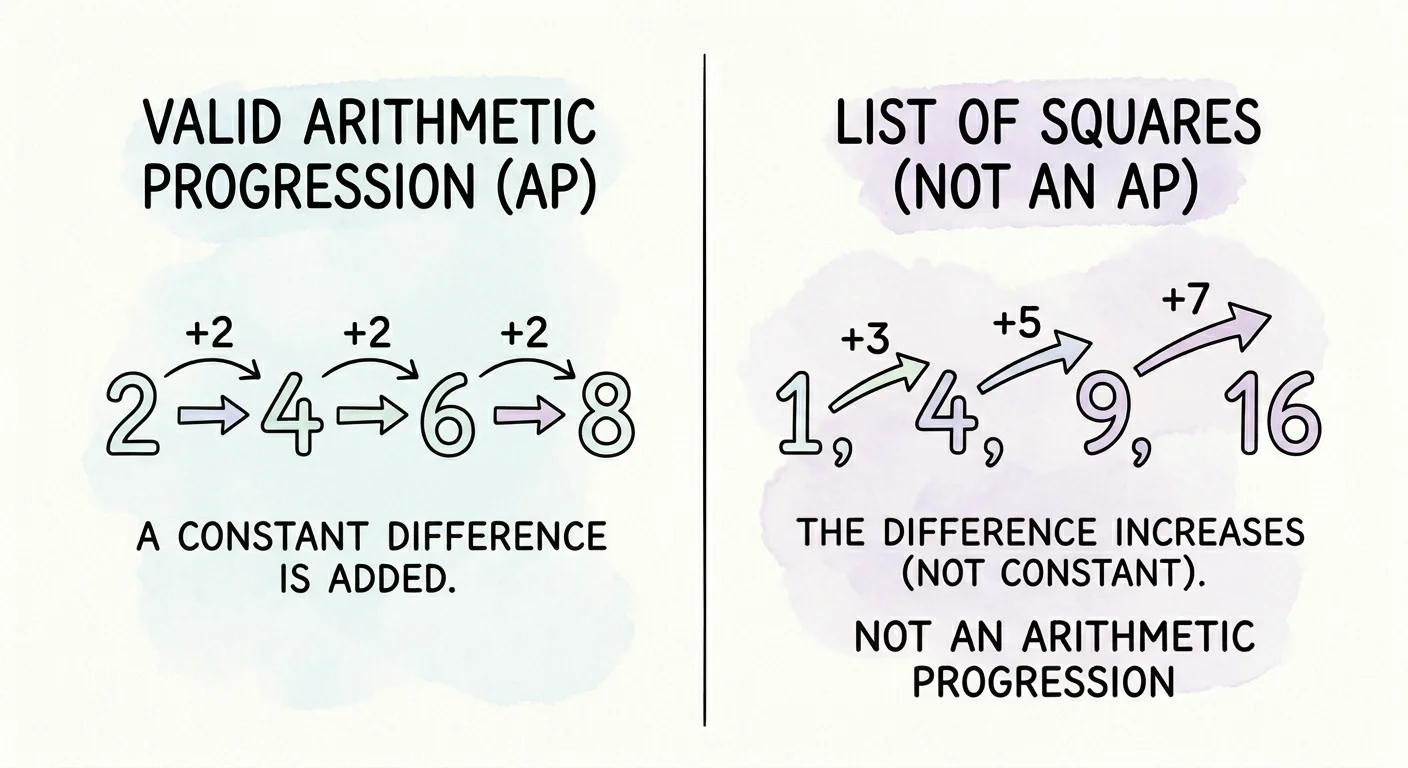
An Arithmetic Progression (AP) is a list of numbers in which each term is obtained by adding a fixed number to the preceding term, except the first term.
A comparison table contrasting APs with non-APs reinforces the definition.

An AP must have a constant step size (common difference) between every term.
Formula for finding d.
For the sequence:
Important Watch-out
Always subtract the preceding term from the succeeding term. Do NOT just subtract the smaller number from the larger number! If the sequence is decreasing, will be negative.
Worked Example 1 from the text.
Problem. For the AP: , write the first term and the common difference .
Faded Example 2(ii) from the text.
To check if the sequence is an AP, we verify if the difference between consecutive terms is the same every time. First, we calculate , which is . Next, we calculate , which gives . Because the difference is identical every time, this list forms an AP with a common difference of . The next two terms are calculated by adding the common difference: . Following that, the term after will be .
Identify which sequence is an AP.
Which of the following lists of numbers forms an Arithmetic Progression (AP)?
Generate the first four terms of an AP given a and d.
Use the general form of an AP () to calculate the first four terms.
List the known values.
State the pattern you will use.
Show how you plug the values in for the 2nd, 3rd, and 4th terms.
Calculate the arithmetic values.
List the four consecutive terms separated by commas.