Factoring for Shortcuts
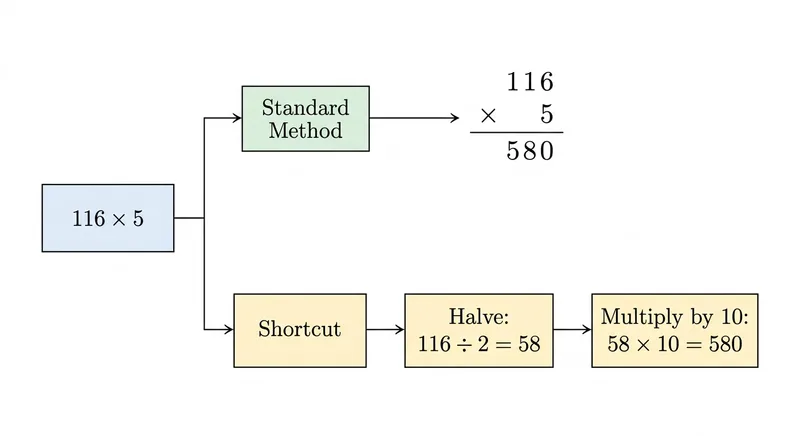
The long way and the shortcut, side by side.
Click to zoom
Breaking numbers into easier factors like 2 and 10 allows you to perform mental math rapidly.
Shortcuts for multiplying big numbers, using patterns and factors.
Preview · progress not saved — Chapter 1 is free
Multiply by 5 or 25 the quick way.
Have you ever tried to multiply large numbers in your head? It can be slow and prone to errors. But numbers often hide patterns that make calculations much easier.
The long way and the shortcut, side by side.
Breaking numbers into easier factors like 2 and 10 allows you to perform mental math rapidly.
Worked example: 116 × 5.
Problem. Calculate the product of quickly using a multiplication shortcut.
The shortcuts for multiplying by 5, 25 and 125.
Work out 824 × 25 with the shortcut, with a worked start.
Let's evaluate 824 × 25 using Estu's shortcut method. Since multiplying by 25 is exactly the same as multiplying by 100 and dividing by 4, we write: 824 × 25 = 824 × (100 ÷ 4).
Multiplying by and dividing by gives the same result. We can compute this more easily by performing the division first: 824 ÷ 4 = .
Finally, we multiply this intermediate result by 100 to get the final answer of .
Work out 25 × 240 quickly.
What is the quickest way to calculate using the shortcut method taught in the chapter?
Group numbers and use shortcuts in a longer product.
Use the associative and commutative properties to rearrange the terms so you can utilize powers of 10.
State the expression you are asked to evaluate.
What property allows you to reorder these numbers?
Rearrange the numbers into pairs that multiply easily into powers of 10.
Show the intermediate product of each pair.
Provide the final multiplied value.
Does the magnitude of your answer make sense?