Back to projectPublic page

15. Body Fluids And Circulation

This section is still being documented. Clone the project to customize it or keep reading for context.

Part of NCERT 11 Biology

39 blocks0 nested pagescreate
Last updated Jan 9, 2026. Clone to remix or explore the blocks below.
a5faedc7...
6666d6f1...
overview

Why Do We Need Blood?

Understanding the transport challenge in living organisms

Why Do We Need Blood?

Every living cell in your body needs:

  • Nutrients (food) to work
  • Oxygen (O2O_2) to produce energy
  • Waste removal (like CO2CO_2) to stay healthy

But most cells are deep inside your body. How do they get what they need?

The Transport Problem: Billions of cells need constant delivery and waste pickup!

04f7004c...
terms

Master the Vocabulary

Essential blood terminology you need to know

1 / 0
Click to reveal
98e82d1e...
concept

Blood: The Liquid Tissue

Understanding blood composition and plasma

Blood: A Special Connective Tissue

Blood is classified as a connective tissue. Why?

  • It has cells (like other tissues)
  • But the cells float in a liquid matrix called plasma
  • It connects all parts of the body through transport

Blood has TWO main components:

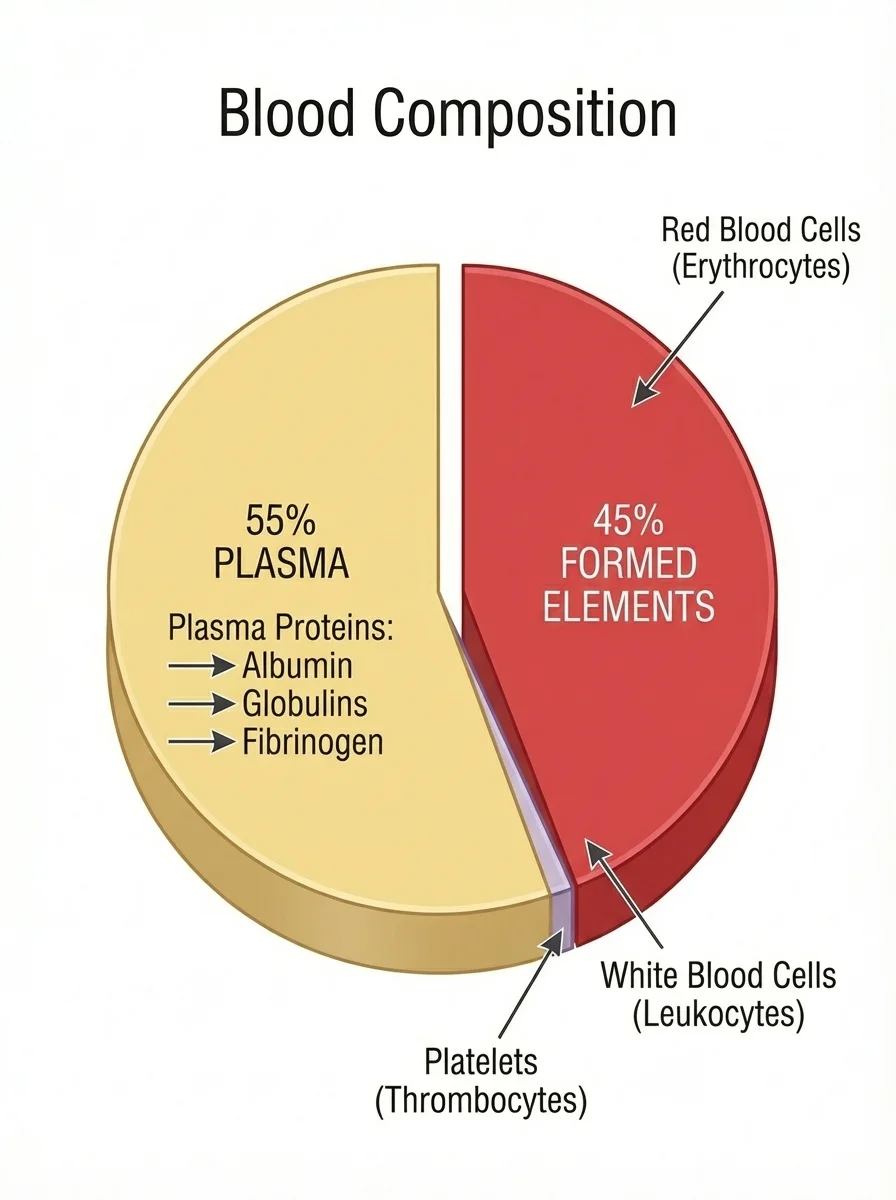
  1. Plasma (55%) - the liquid part
  2. Formed elements (45%) - the cells and cell fragments
d707b9fa...
visual

Blood Composition

See what blood is made of at a glance

Pie chart showing blood composition: 55% plasma (straw colored) and 45% formed elements (red), with detailed breakdown of plasma proteins and formed elements types
Click to zoom

Blood is 55% liquid (plasma) and 45% cells. The plasma itself is mostly water (90-92%) with proteins making up 6-8%.

ab425917...
concept

Formed Elements: The Cells

RBCs, WBCs, and Platelets - what they do

Formed Elements of Blood

Formed elements = cells and cell fragments in blood

They make up 45% of blood volume.

Three types:

  1. Erythrocytes (Red Blood Cells - RBCs)
  2. Leucocytes (White Blood Cells - WBCs)
  3. Platelets (Thrombocytes)

Each has a special job!

9a8d01e9...
anatomy

The Blood Cell Family

Visual guide to all cells in your blood
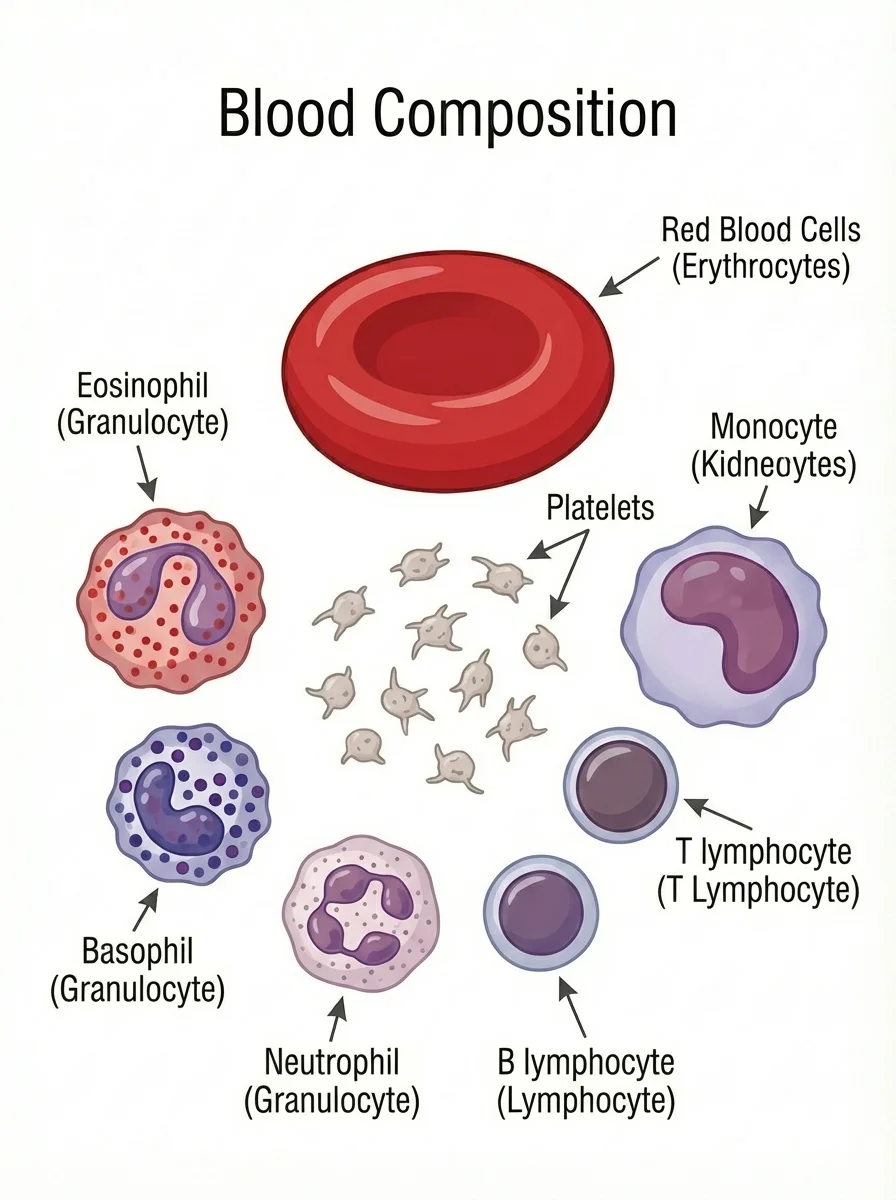
Diagrammatic representation of all formed elements in blood: one large red blood cell (RBC), multiple small platelets, eosinophil with red granules, basophil with blue granules, neutrophil with multi-lobed nucleus, monocyte large with kidney-shaped nucleus, T lymphocyte small round, B lymphocyte small round
Click to zoom

RBCs are the most numerous (5 million per mm³). WBCs are fewer but powerful defenders. Platelets are the smallest - they're cell fragments, not complete cells. Each has a unique shape and job!