Intersecting Lines & Angles Visual
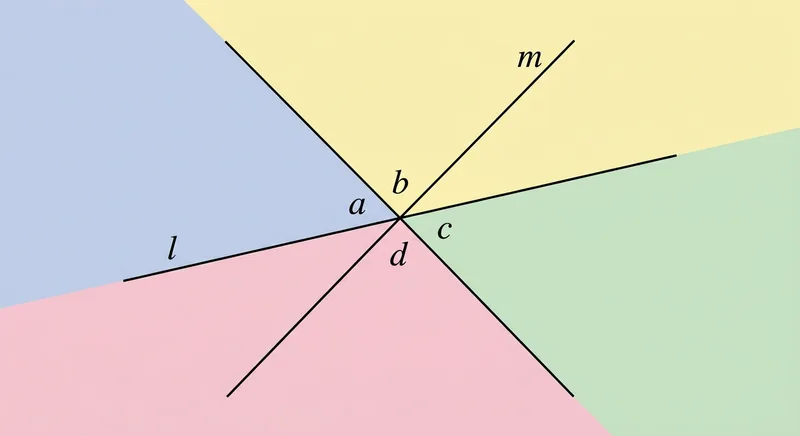
Geometry requires figures to show the 4 angles formed by intersection.
Click to zoom
Intersecting lines meet at a single point and always form four distinct angles.
Understand that intersecting lines create linear pairs summing to 180° and vertically opposite angles that are equal.
Preview · progress not saved — Chapter 1 is free
Introduction to intersection and the four angles formed.
When you observe lines around you—like on a bulletin board or a tiled floor—some of them are bound to meet.
When a pair of straight lines cross each other at a single point on a flat surface, we say that the lines intersect.
Geometry requires figures to show the 4 angles formed by intersection.
Intersecting lines meet at a single point and always form four distinct angles.
Formal definitions of linear pairs and vertically opposite angles.
Step-by-step calculation of angles based on Fig 5.2.
Two straight lines intersect, forming four angles labeled , and in a circle. We are given that . Calculate the values of the other three angles.
Faded example where one angle is given as 75°.
Let two lines intersect, forming four angles: , and . Suppose we are given that angle is . Because angle and angle form a linear pair on a straight line, they must add up to . We can calculate angle by subtracting from , which gives us . Now, since angle and angle are vertically opposite angles, their measures must be . Therefore, angle also measures . Finally, angle and angle are vertically opposite, so angle must measure .
Match pairs of angles to their relationship (Linear vs Vertically Opposite).
Terms
Definitions