Intersecting Arcs
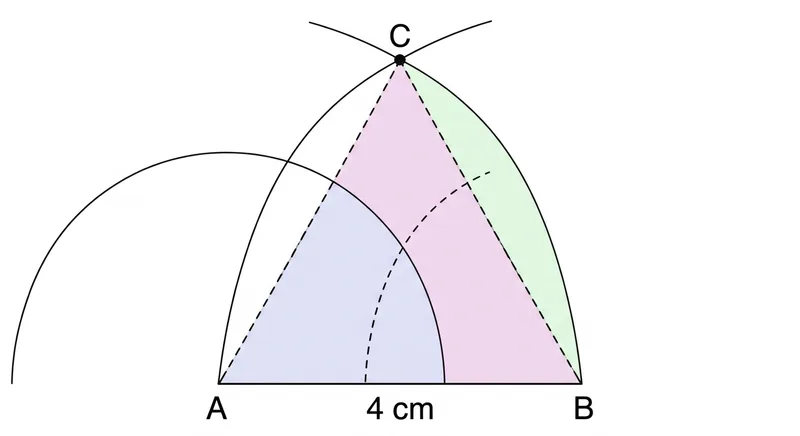
Shows the step-by-step intersection of arcs from vertices.
Click to zoom
The intersection of the two arcs identifies the exact location where the distance from both base vertices is equal.
Learn to accurately construct an equilateral triangle using a compass and straightedge.
Preview · progress not saved — Chapter 1 is free
Explain why using only a ruler requires trial and error.
If you try constructing an equilateral triangle of using just a ruler, you might easily draw a base AB of . But accurately marking the third point C requires making sure both AC and BC are exactly at the same time.
A compass arc represents all points at an exact distance from the center.
Setting a compass to a specific radius (like ) and drawing an arc creates a geometric boundary where every single point on that arc is exactly that distance away from the center point.
Shows the step-by-step intersection of arcs from vertices.
The intersection of the two arcs identifies the exact location where the distance from both base vertices is equal.
Step-by-step construction of a 4 cm equilateral triangle.
Problem. Construct an equilateral triangle ABC with a side length of .
Partially solved steps for constructing a 6 cm equilateral triangle.
To construct a larger equilateral triangle, first draw a base line segment AB with a length of . Next, set your compass to a radius of and draw intersecting arcs from both points A and B. The point where these arcs cross is vertex C. Because the arcs were drawn with the exact same compass setting, joining AC and BC guarantees that the final side lengths are exactly .
Question checking the conceptual understanding of the compass arc.
Why does the intersection point C guarantee that ?
Applying the equilateral method to form isosceles triangles from circles.
Problem: You are given a circle with center . Points and lie on the circle's circumference. If you draw triangle , explain step-by-step why it must be an isosceles triangle.
List the key points and their locations.
State the rule concerning distances from the center of a circle to its circumference.
Which two sides of triangle ABC must be exactly equal based on this principle?
Conclude the classification of the triangle based on its side lengths.