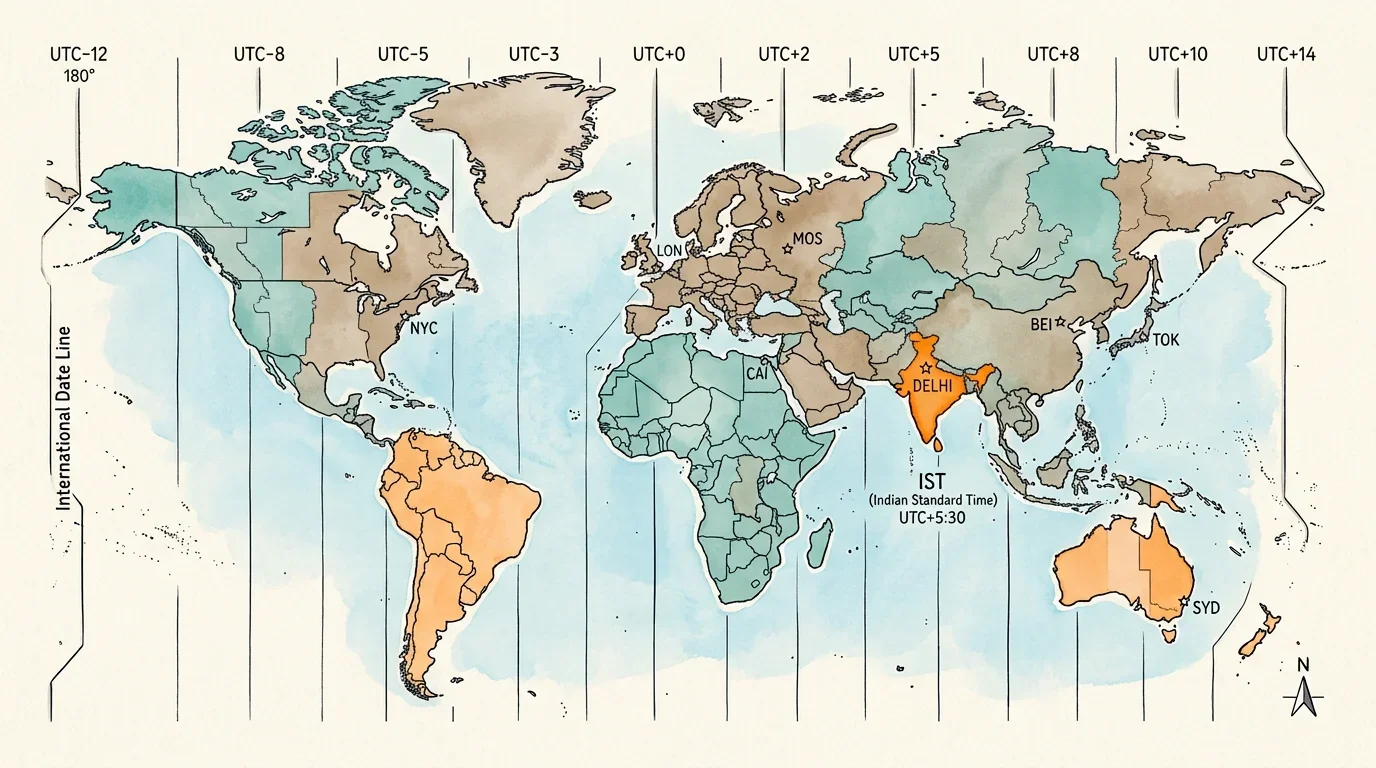
How longitude sets the time, why India has one standard time, and what happens at the International Date Line.
Preview · progress not saved — Chapter 1 is free
Why the sun sets in Assam while it's still light in Gujarat.
If two friends are speaking on the phone late in the afternoon—one sitting in Tinsukia (Assam) and the other in Porbandar (Gujarat)—the friend in Assam might see that the sun has already set and it is completely dark! Meanwhile, the friend in Gujarat will be shocked because they are still experiencing bright daylight. This happens because longitude determines local time across the globe!
Earth turns 15° every hour: how longitude sets the time.
Our planet spins around its axis from west to east, completing a full turn every 24 hours. Because of this continuous rotation, different places on Earth experience daylight at different times.
The 15°-per-hour rule, and the world's time zones.
Calculate time differences from longitude.
If it is 12:00 Noon at Greenwich (0°), what is the local time at 30° East longitude?
Standard time, Indian Standard Time and the International Date Line.
Using exact local time for every single town would cause massive confusion for train schedules, flights, and communication. To solve this, countries adopt a standard time based on a central meridian passing through them.
What happens to the date when a plane crosses the Date Line.

Crossing the International Date Line forces a calendar adjustment: adding a day when traveling west, and subtracting a day when traveling east.
Check the facts about standard time and the Date Line.
Indian Standard Time (IST) is hours ahead of Greenwich Mean Time (GMT). Because of their vast size, large countries like Russia and the USA require multiple time instead of a single uniform clock. On the opposite side of the Earth from Greenwich, the International Date Line is located approximately at degrees longitude. The boundary intentionally zig-zags across the ocean to avoid dividing a single country into two different .