Polynomial Basics Visual
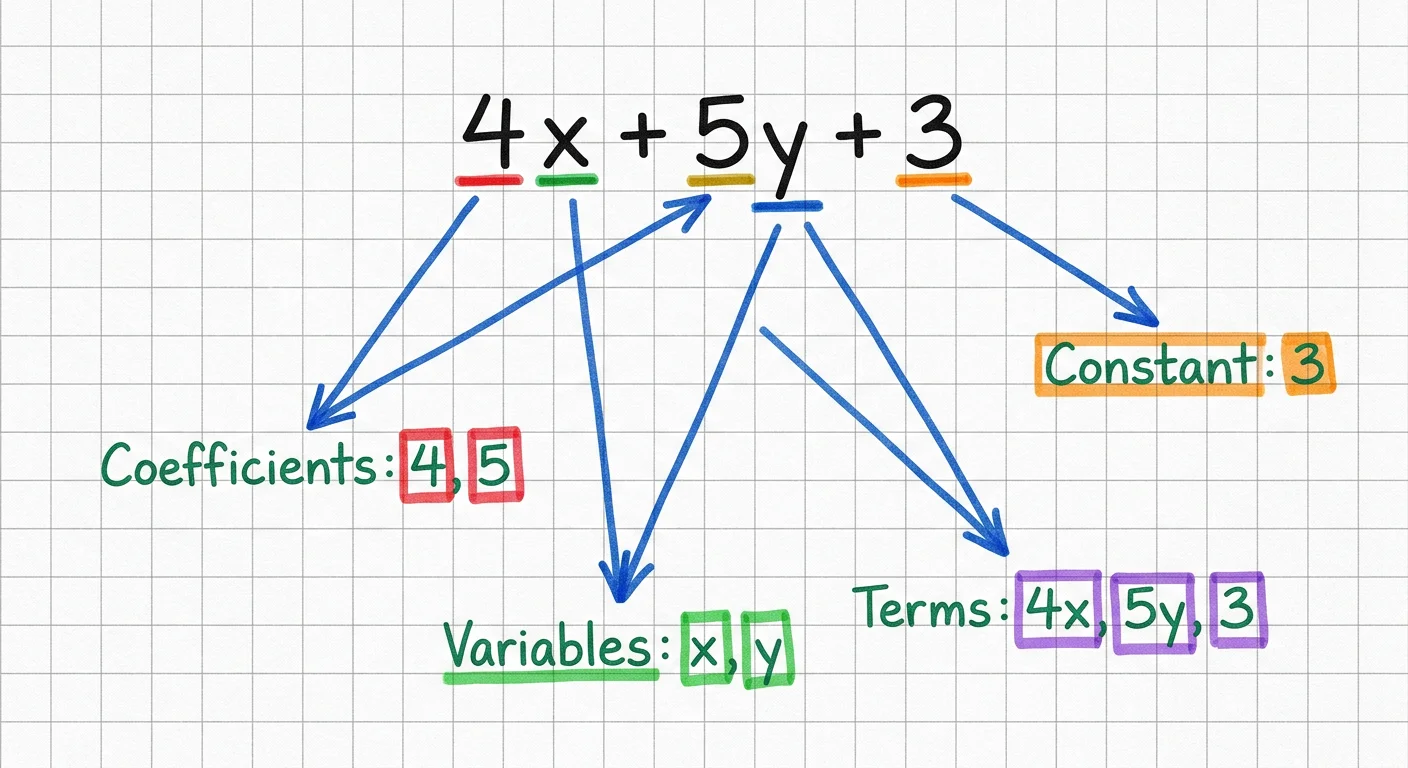
Annotated equation mapping parts of an expression to vocabulary terms.
Click to zoom
Mapping out terms, coefficients, variables, and constants in an algebraic expression.
Define algebraic terms, variables, coefficients, and degree of one-variable polynomials.
Preview · progress not saved — Chapter 1 is free
Introduction using Raju's stationary box example.
Imagine you go to a stationery shop. You buy sealed red boxes, each containing 4 pens. Then, you buy sealed blue boxes, each containing 5 pencils. To top it off, the shop owner gives you 3 extra pens for free.
How many total items do you have? You can represent this with the algebraic expression:
Annotated equation mapping parts of an expression to vocabulary terms.
Mapping out terms, coefficients, variables, and constants in an algebraic expression.
Define one-variable polynomials and their degrees.
Expressions like have multiple variables ( and ). But what if an expression only has one variable, like or ?
Algebraic expressions involving only one variable and its powers are called univariate polynomials (or simply polynomials).
The degree tells us the highest power of the variable.
No variable power is present.
Highest power of the variable is 1.
Highest power of the variable is 2.
Highest power of the variable is 3.
Worked example from Exercise 2.1.
Problem 1. Find the degree of the following polynomial:
Faded example for degree and constants.
Let us analyze the polynomial to understand its properties. First, we identify the terms, which are , , , and the number at the end. To find the highest power of the variable , we look at the exponents in each term. The highest power of is , which tells us the degree of the polynomial. Therefore, this is a polynomial of degree and is called a cubic polynomial. Finally, we look for the term that does not contain a variable, which means the constant term is .