Function as an Input-Output Machine
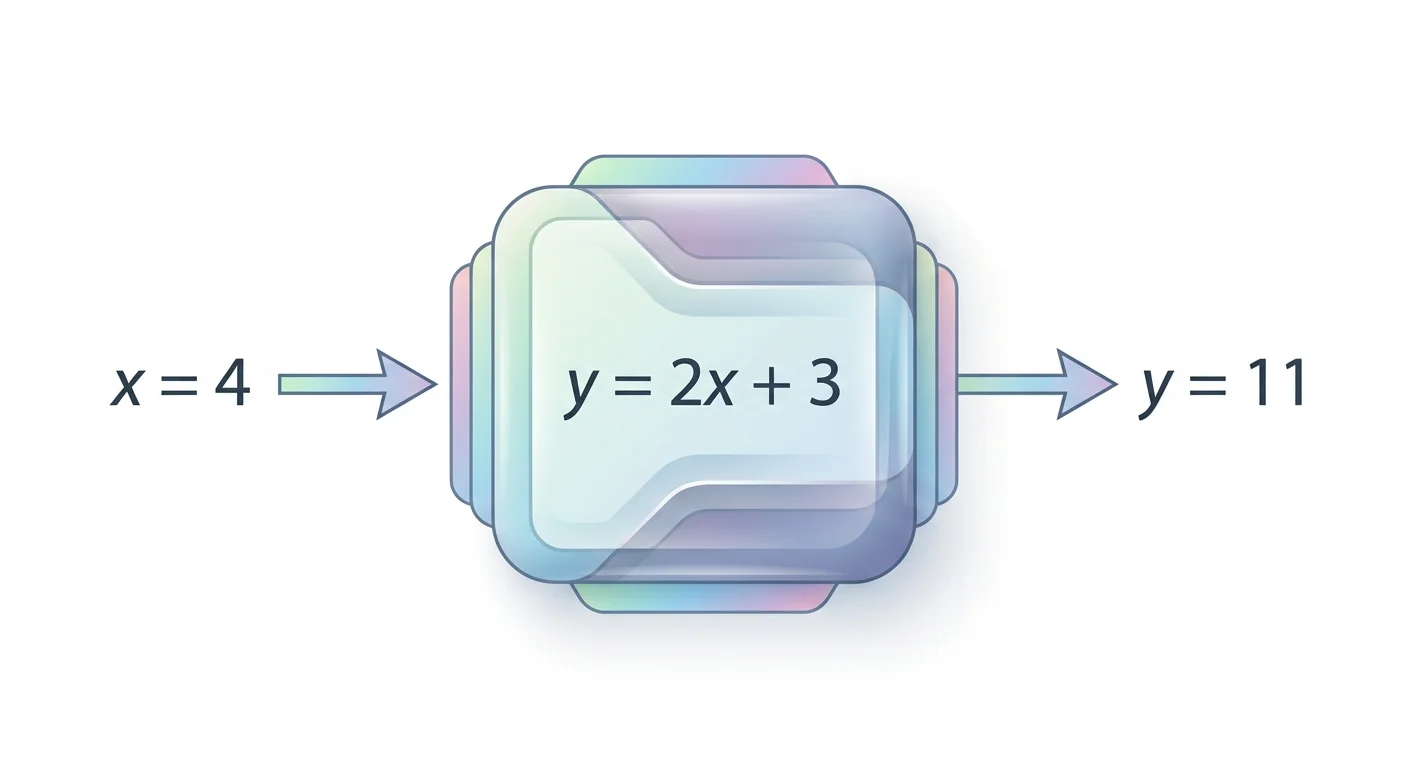
Input-output machine diagram.
Click to zoom
A linear function acting as an input-output process.
Define linear polynomials, equate them to constants to form equations, and view them as input-output functions.
Preview · progress not saved — Chapter 1 is free
Introduce linear polynomials and equating them.
A polynomial of degree 1 is called a linear polynomial. For example, the perimeter of a square with side is .
Here, is a linear polynomial representing a physical dimension.
Input-output machine diagram.
A linear function acting as an input-output process.
Explain how polynomials act as functions.
Polynomials can be thought of as input-output processes, which are often referred to as functions.
For every value you input into the variable, there is a corresponding single output value.
Worked example solving a sum problem.
Problem. The sum of two numbers is . One of the numbers is more than the other. What are the two numbers?
Faded example based on Exercise 2.2.
Let's find the present ages based on the following problem: Salil's mother is 3 times his age, and after 5 years, their ages will add up to 70 years. If we let Salil's present age be , then his mother's present age is . After 5 years, Salil's age will be and his mother's age will be . Adding their future ages together, we can write the equation as . Combining the like terms on the left side gives us the linear equation . Subtracting 10 from both sides gives . Dividing by 4, we find that Salil's present age is years.
Evaluate a linear polynomial at different inputs.
Terms
Definitions
Guided word problem about coins.
Define your variables based on the problem statement.
Write the linear equation. (Value of coin × number of coins)
Combine the terms to simplify the polynomial.
Calculate the value of the variable.
State the final number of each coin type.
Multiply your coin counts by their values to ensure they add up to ₹88.