189832b9...
314c2206...
f6747c01...
c50bedb2...
e86b6b76...
94dd2758...
2d3f446a...
The student adds 5-digit and 6-digit numbers in column form and knows what a carry over is and where it goes.
Preview · progress not saved — Chapter 1 is free
The names for the parts of an addition, and the order the columns are worked in.
The numbers which we add are called addends. The answer we get after adding them is the sum. For example, in the equation , the numbers 2 and 3 are the addends, and 5 is the sum.
Example 1 from page 19, with an arrow on every column showing the working order.
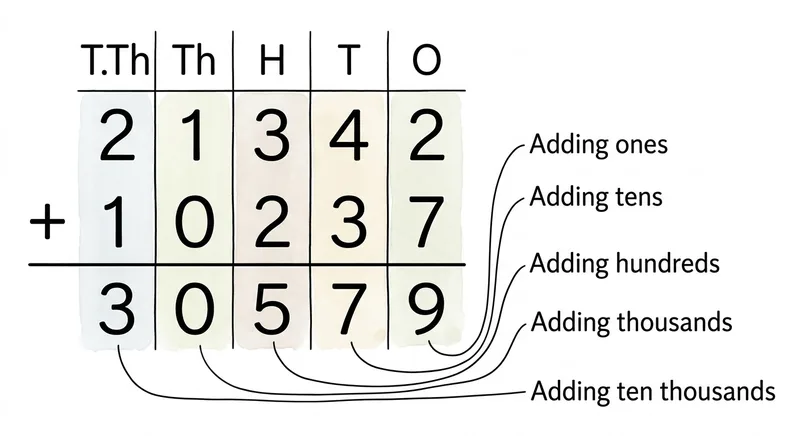
Always start adding from the ones column on the far right.
Example 1 from page 19, worked one column at a time.
Problem. Add 21,342 and 10,237.
Worksheet 1 question 1(a), already arranged in columns.
Let's add 12,142 and 53,807 in column form under the headings T.Th, Th, H, T, and O. First, we add the ones column: 2 + 7 = 9. Next, we add the tens column: 4 + 0 = . Then, we add the hundreds column: 1 + 8 = . Moving left, we add the thousands column: 2 + 3 = . Finally, we add the ten thousands column: 1 + 5 = . Combining these digits gives us the final sum of .
When a column adds to ten or more, one ten moves across to the next column.
When adding numbers in columns, each place value column can only hold a single digit (0 through 9). If a column adds up to 10 or more, we use a process called a carry over.
Example 2 from page 19: 23,935 plus 53,441 plus 21,253.
Problem. Add 23,935; 53,441 and 21,253.
Example 3 from page 20, where one column carries 2.
Problem. Add 4,37,816; 2,29,318 and 3,21,359.