Image Slideshow
A visual journey through images

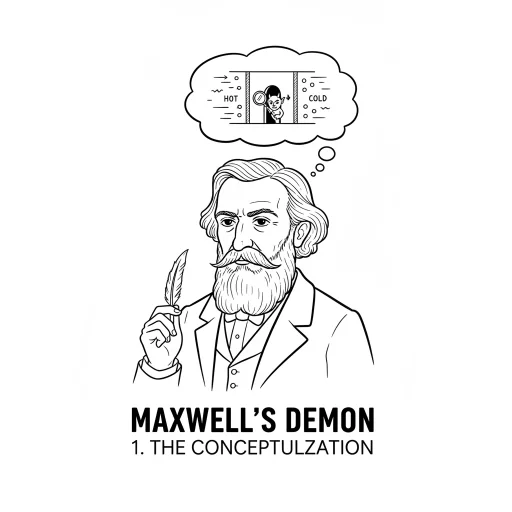
Imagine James Clerk Maxwell, in the late 19th century, pondering the Second Law of Thermodynamics. He hypothesized a thought experiment to seemingly violate it.

He envisioned a chamber divided into two compartments by a tiny door, both initially filled with gas at the same temperature.

He then introduced a "demon" – a tiny, intelligent being guarding the door.

The demon's task: open the door only for fast-moving molecules heading to one side, and slow-moving molecules heading to the other.

This sorting would lead to one side becoming hotter and the other colder, without any work being done – seemingly decreasing entropy, a violation of the Second Law of Thermodynamics!

Decades later, scientists like Leo Szilard and Leon Brillouin showed that the demon must acquire and store information about the molecules' speeds. This act of acquiring and storing information itself increases entropy elsewhere in the universe, thereby upholding the Second Law.

This led to Landauer's Principle (1961), which states that erasing one bit of information dissipates a minimum amount of energy as heat, thus increasing entropy. The demon's memory needs to be reset, costing energy.

Maxwell's Demon thus beautifully linked information theory with thermodynamics, showing that information is a physical quantity with thermodynamic implications.

This concept is crucial in understanding the limits of computation and is highly relevant to fields like nanotechnology and the design of energy-efficient computing.