Imagine a future where Earth is slowly dying
A visual journey through images

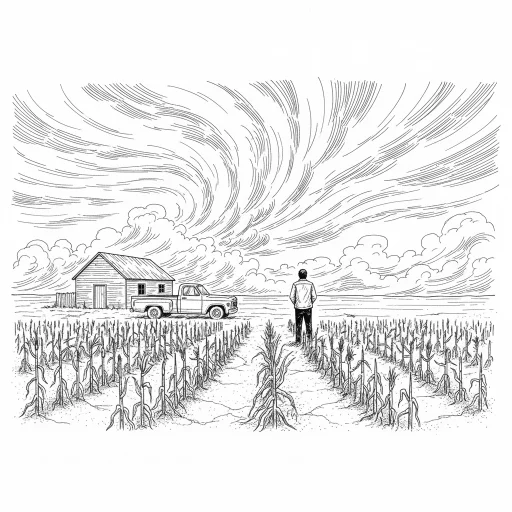
Imagine a future where Earth is slowly dying. A mysterious blight is turning all crops to dust, and humanity is running out of food and breathable air. Dust storms plague the land, and our only hope is to look beyond our world.

Our hero, Cooper, is a former pilot now a farmer, trying to provide for his two children, Murph and Tom. But when a strange anomaly leads him to a secret NASA facility, he's given an impossible choice: leave his family to save humanity, or stay and watch them perish.

Before Cooper leaves, Murph believes a "ghost" in her room is sending messages by knocking books off shelves in a peculiar pattern. This mysterious force, which turns out to be gravity, is trying to communicate, hinting at something beyond our comprehension.

Cooper joins a team of astronauts aboard the Endurance, a spacecraft designed for deep space travel. Their mission: to journey through a newly discovered wormhole near Saturn and find a habitable planet for humanity.

Their perilous journey begins by entering a wormhole—a theoretical "shortcut" through space-time. Imagine our universe as a flat sheet. To get from point A to point B, you can travel across the sheet, or you can fold the sheet, creating a bridge (the wormhole) that connects the two points instantly.

Emerging from the wormhole, the crew finds themselves in an entirely new galaxy, orbiting a supermassive black hole named Gargantua. This gargantuan black hole is the gravitational heart of the system they've arrived in, dictating the fate of its surrounding planets.

Their first stop is a planet orbiting Gargantua, covered entirely by shallow water and immense waves, which they call Miller's Planet. Here, gravity is so intense it warps time itself. For every hour spent on this water-world, seven Earth years pass by! This extreme warping of time is called time dilation, a crucial concept from Einstein's theory of relativity.

When Cooper and Brand return from Miller's Planet, only a few hours have passed for them, but decades have gone by for Romilly, who remained on the Endurance. This stark difference in experienced time highlights the profound impact of gravity on the fabric of space-time and the sacrifices made in their mission.

Following a faint signal, the crew travels to Mann's Planet, a frozen, ammonia-filled world. Dr. Mann, a celebrated astronaut thought to be a hero, has sent a false signal, hoping to be rescued. This act of desperation puts the entire mission and crew in grave danger.

After a violent confrontation, Mann attempts to dock his ship with the Endurance, causing a catastrophic explosion. Cooper, in a desperate, gravity-defying maneuver, manages to dock their damaged lander with the spinning Endurance, saving Brand and TARS in a breathtaking display of skill and understanding of rotational physics.

Faced with few options, Cooper makes a final, desperate choice: to enter Gargantua. As he falls into the black hole, he doesn't find oblivion, but instead a "tesseract"—a fifth-dimensional space constructed by future humans. This tesseract allows him to perceive time as a physical dimension, giving him a unique vantage point.

Inside the tesseract, Cooper realizes he is the "ghost" Murph saw. He uses gravity to manipulate books on the shelf in Murph's old room, sending her messages in Morse code. He transmits crucial data about quantum mechanics, information vital for humanity's survival.

Decades later, the adult Murph, now a brilliant scientist, deciphers Cooper's message. The data reveals the solution to "gravity equation," enabling humanity to master gravitational forces and escape Earth's dying surface.

Thanks to Murph's breakthrough, humanity constructs massive O'Neill Cylinders—gigantic space colonies designed to house millions. These self-sustaining habitats become the new home for the human race, floating peacefully among the stars.

One of these magnificent space colonies is named Cooper Station, in honor of Cooper's sacrifice and Murph's ingenuity. It orbits Saturn, a symbol of hope and a testament to humanity's enduring spirit.

Miraculously, Cooper is ejected from the tesseract and rescued by a passing Ranger spacecraft. He awakens on Cooper Station, where he is finally reunited with his daughter, Murph, who is now an elderly woman, having lived a full life while he barely aged due to time dilation.

Meanwhile, Brand, the other surviving astronaut, reaches Edmund's Planet, a potentially habitable world they had targeted. She discovers it is indeed suitable for life and begins the lonely but hopeful task of establishing a new human colony.

Despite the reunion, Cooper knows his journey isn't over. With humanity safe, he sets off again in a Ranger spacecraft, determined to find Brand and help her build a new civilization on Edmund's Planet, driven by love and a renewed sense of purpose.

Interstellar explores the profound concepts of time, gravity, and love as fundamental forces. It suggests that while science can explain the universe, human connection and the drive to survive are equally powerful, capable of transcending dimensions and saving humanity.

The story ends with a message of hope. Humanity has not only survived but thrived by embracing the unknown and understanding the universe's most complex principles. It's a testament to our ingenuity, sacrifice, and the boundless possibilities that lie beyond our home planet.