Triangle ACD
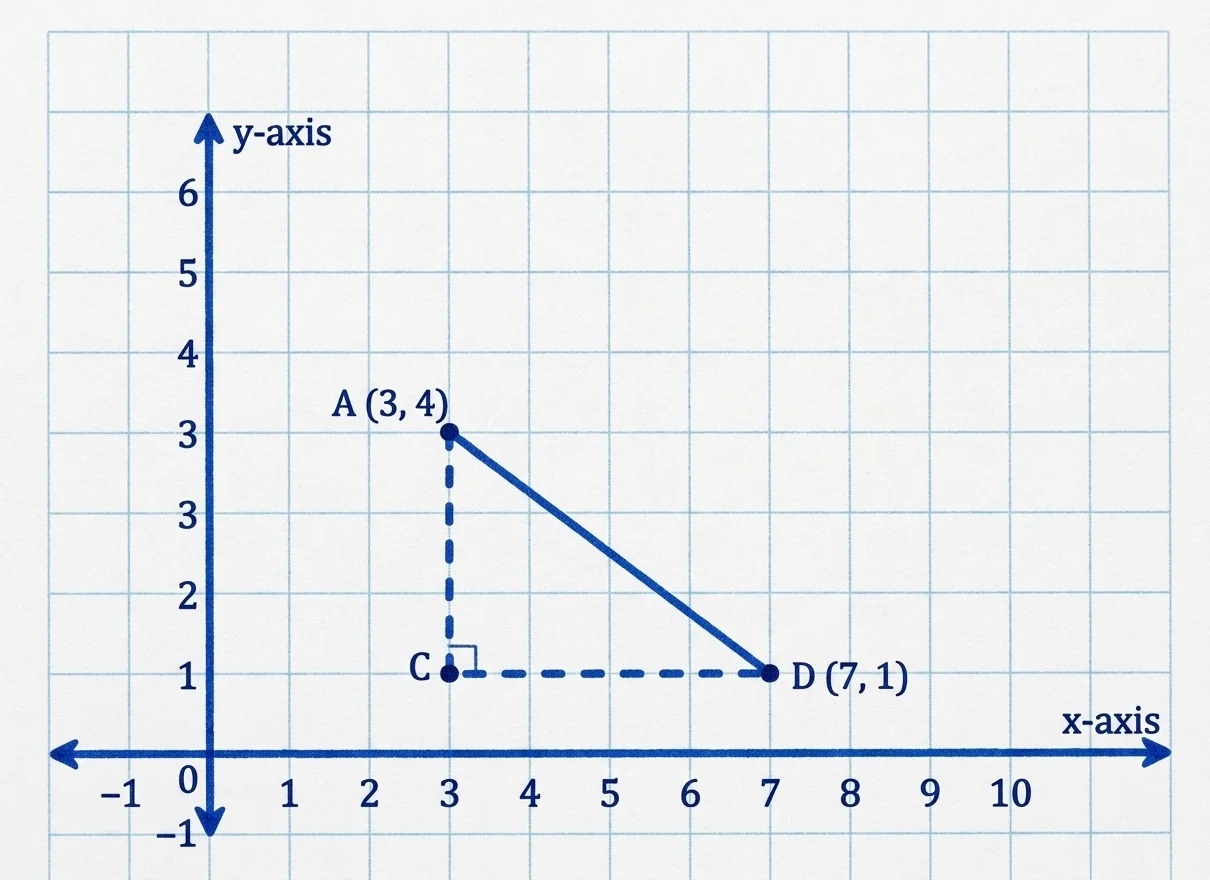
A right-angled triangle that helps measure a slanted side.
Click to zoom
Creating a right-angled triangle ACD helps us calculate the slanted length of side AD.
Work out the distance formula from Pythagoras, and use it to measure slanted lines.
Preview · progress not saved — Chapter 1 is free
How do you measure a line that isn't straight across or straight up?
When points are aligned horizontally or vertically, finding the distance is simple: we just count the units along the grid or subtract the values on that axis.
A right-angled triangle that helps measure a slanted side.
Creating a right-angled triangle ACD helps us calculate the slanted length of side AD.
Worked example: the length of AD using Pythagoras.
Problem. Find the length of side AD for triangle ADM, given the starting coordinate and the ending coordinate .
The formula for the distance between any two points.
After adding the squares of the coordinate differences, you must remember to take the square root at the very end to find the actual distance.
Your turn: find the length of DM.
We want to find the distance between A(-4, 6) and B(5, -2). The distance formula is . First think about how far the x-coordinate moves from A to B. The change in x-coordinate is . Next think about how far the y-coordinate moves from A to B. The change in y-coordinate is . Now use these two changes in the distance formula. After squaring both changes and adding them, the number under the square root becomes . Therefore, the distance between the two points is units.
Reflect a triangle across an axis: the signs change, the lengths don't.
What happens to the lengths of sides if we reflect a shape across one of the axes? Let's take triangle ADM and reflect it across the y-axis to create a mirror image, triangle A'D'M'.