Student applies the division algorithm to solve exact divisibility adjustments.
Division by zero, division by one, inverse facts.
When working with whole numbers, division behaves in specific, predictable ways. Let's review the core properties.
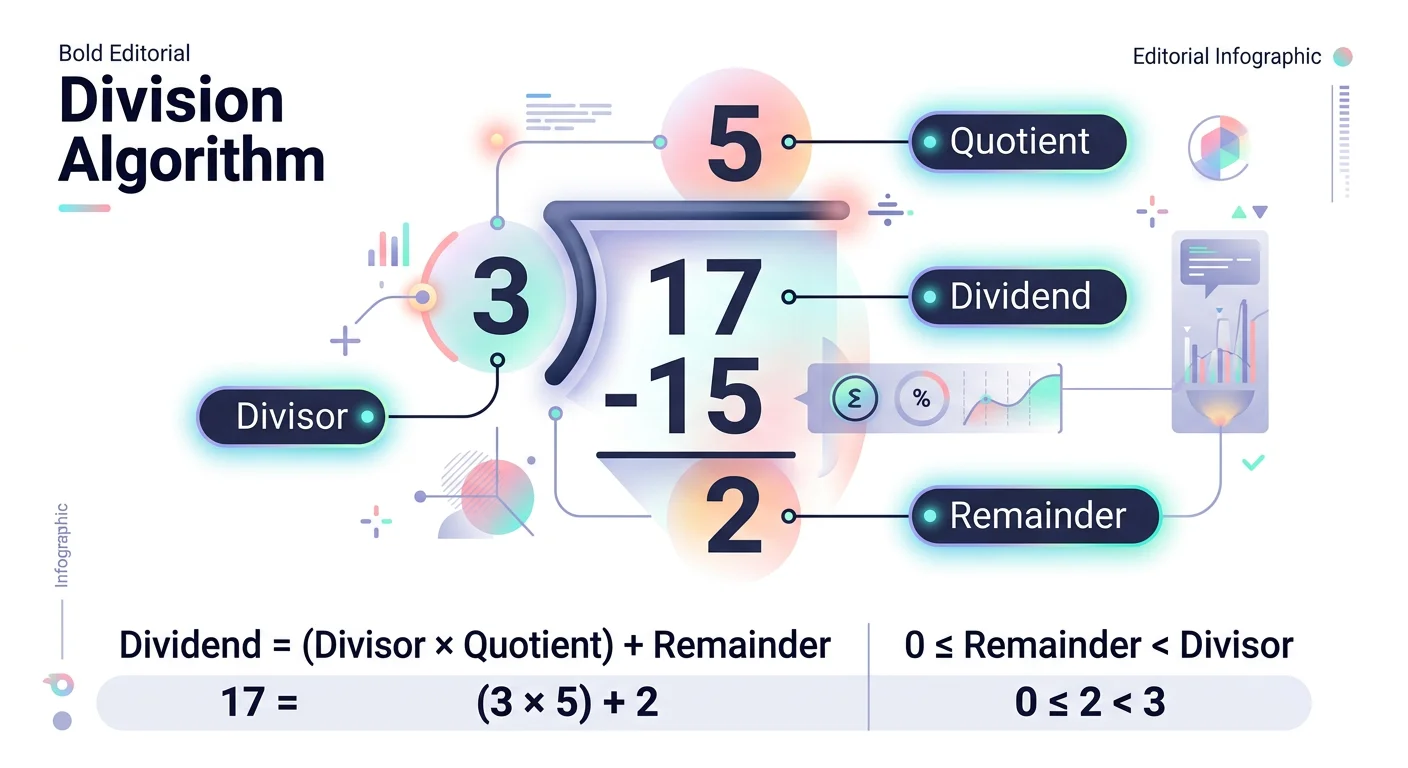
A structural mapping of Dividend, Divisor, Quotient, and Remainder clarifies the formula.

Dividend: the number being divided
Divisor: the number we divide by
Quotient: the whole-number answer
Remainder: what is left over
When is divided by :
So, the quotient is and the remainder is .
Using remainder to find exact divisibility.
Find the least number that should be subtracted from so that divides the difference exactly.
Using Divisor-Remainder to find exact divisibility.
Let us solve the problem of finding the least number that should be added to 1000 so that 35 divides the sum exactly.
First, we divide 1000 by 35, which gives a quotient of 28 and a remainder of .
To determine what must be added, we find the difference between the divisor and the remainder. We calculate this difference as .
Therefore, should be added to 1000 so that the sum 1015 is exactly divisible by 35. This method ensures we are stepping up to the next multiple rather than subtracting down to a previous one.
Worksheet problem to find number to add.
Find the smallest number that should be added to so that the result is divisible by .
In other words, make this number divisible by :
Hint: First divide by and find the remainder.
Divide 2000 by 45 and find the remainder.
To reach the next multiple of 45, subtract the remainder from 45.
Add your answer to 2000 and check that the result is divisible by 45.
Write the smallest number that should be added.