Back to projectPublic page

Physics MCQ

This section is still being documented. Clone the project to customize it or keep reading for context.

Part of Daily IIT-JEE Practice

1 block0 nested pages
Last updated Dec 29, 2025. Clone to remix or explore the blocks below.
50fc2ee2...
JEE Physics

Why Doubling Light Intensity Doesn't Double Electron Energy

Go beyond formulas. Understand why Einstein's photoelectric effect revolutionized physics - and how it appears in JEE.
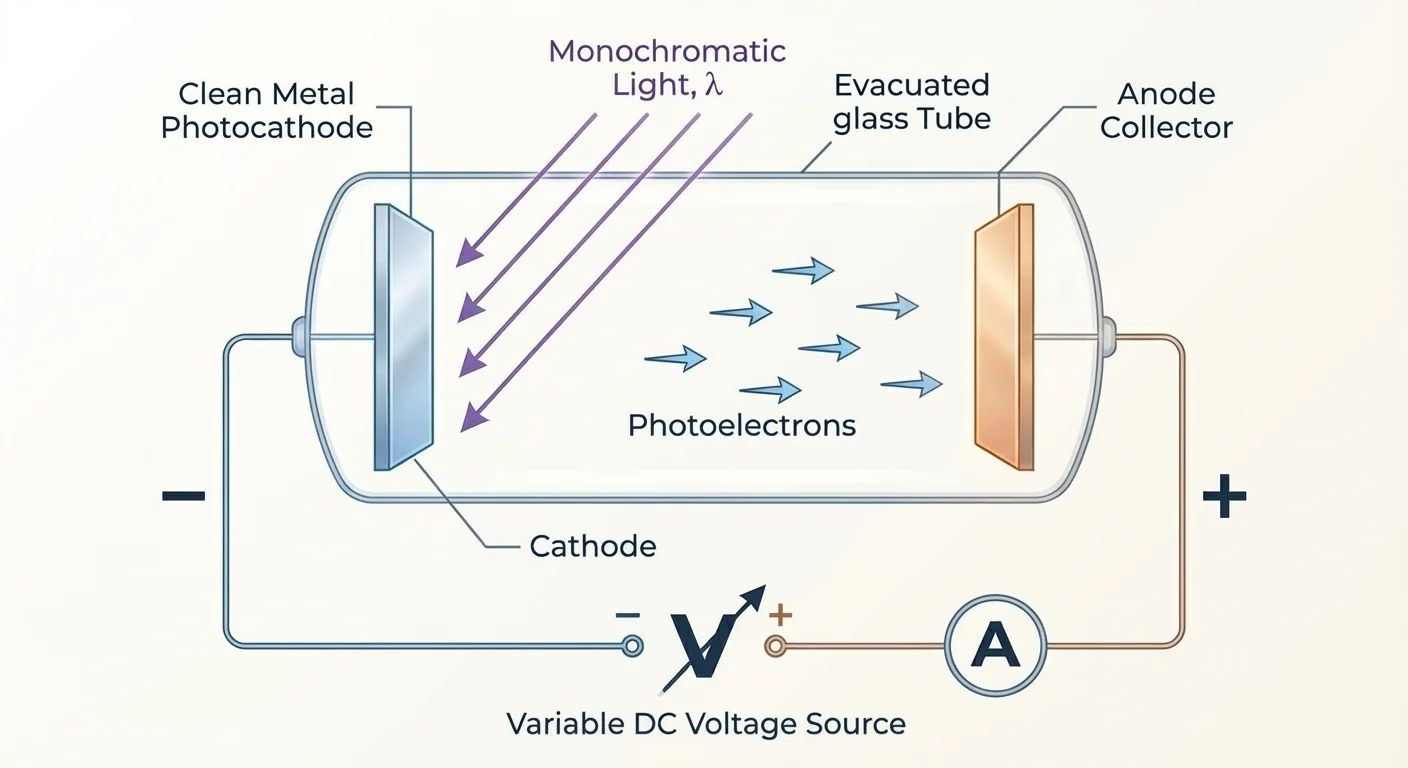
Diagram of photoelectric effect experimental setup showing an evacuated glass tube with a clean metal photocathode (emitter plate) on the left and an anode (collector plate) on the right. Monochromatic light rays (shown as parallel arrows with wavelength lambda) are incident on the photocathode from the left. A variable DC voltage source V is connected between the plates with positive terminal to collector and negative to emitter. An ammeter A is connected in series to measure photocurrent. Ejected photoelectrons are shown as small arrows moving from cathode to anode. The circuit is complete with clearly labeled components.
Click to zoom
Experimental setup for studying the photoelectric effect

When electromagnetic radiation of sufficiently high frequency strikes a metal surface, electrons are emitted from the surface. This phenomenon is called the photoelectric effect.

Key equation: Maximum kinetic energy of photoelectron

Kmax=hνϕK_{\text{max}} = h\nu - \phi

where hh is Planck's constant (6.63×1034Js(6.63 \times 10^{-34} \text{J}\cdot\text{s}, ν\nu is the frequency of incident light, and ϕ\phi is the work function of the metal.

0 / 4

If the intensity of incident light is doubled while keeping the frequency constant (above threshold), what happens to the maximum kinetic energy of emitted photoelectrons?